
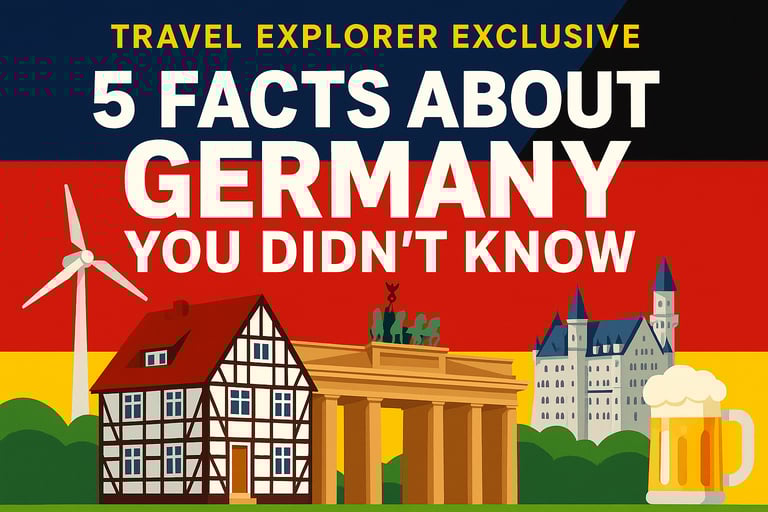
5 Facts About Germany You Didn’t Know in 2026 – Travel Explorer Exclusive
Discover 5 incredible and lesser-known facts about Germany in 2026. From futuristic cities to ancient mysteries, this Travel Explorer Exclusive reveals the hidden side of one of Europe’s most fascinating destinations.
EUROPE
11/6/20253 min read
Introduction: Germany, Reinvented
Germany has always been famous for its beer, cars, and castles — but 2026’s Germany is a whole new story. It’s a country that’s blending history, innovation, and sustainability like no other place in Europe.
From futuristic cities run by AI to fairytale castles hiding high-tech secrets, this Travel Explorer Exclusive reveals five amazing facts about Germany that will totally change how you see the country.
1. Germany Is Now Europe’s Green Energy Superpower 🌍
Forget coal — Germany has gone full eco. In 2026, over 55% of its energy comes from renewables, making it Europe’s most sustainable country.
Entire neighborhoods generate their own electricity using solar rooftops and wind farms. In Freiburg’s Vauban eco-district, cars are nearly banned, and every home is energy efficient.
What’s wild? Most of these renewable projects are community-owned. Regular citizens literally profit from selling green energy back to the grid. It’s not just a clean revolution — it’s a democratic one.
2. You Can Sleep Inside Real Medieval Castles 🏰
Sure, everyone’s heard of Neuschwanstein Castle, but Germany has more than 25,000 castles — many you’ve never heard of and can actually stay in.
Hidden deep in valleys or sitting above vineyards, these castles are part hotel, part time machine. Some, like Burg Eltz and Hohenzollern, still belong to noble families. Others have been transformed into boutique resorts where you can sleep under chandeliers from the 1400s.
Even better — many now offer AR-guided tours, letting you see what life looked like centuries ago through your phone. So yeah, Germany’s castles aren’t just ancient; they’re interactive.
3. Germany Built the World’s First AI-Governed City 🤖
Welcome to Aachen SmartCity — a real place where artificial intelligence helps run everything.
Launched in 2024 and fully operational by 2026, Aachen uses a central AI called “Helios” to manage traffic lights, waste systems, public transport, and even energy distribution. The result? Fewer traffic jams, cleaner air, and happier citizens.
Visitors can experience the future firsthand: smart benches that charge your phone, drone taxis that shuttle across the city, and intelligent street art that interacts when you walk by.
Germany didn’t just build a city — it built a living, breathing experiment in urban innovation.
4. The German Language Has Gone Digital 💬
If you haven’t heard of “Netzdeutsch,” you will. By 2026, Germany’s younger generation speaks a mix of German, English, and internet slang.
It’s a wild blend of emojis, memes, and multicultural words — shaped by social media, online gaming, and AI translators. In Berlin, young people switch between English, Arabic, and Turkish-infused German in one sentence.
It might sound chaotic, but it’s proof that Germany’s culture is constantly evolving. Linguists call it the most dynamic language shift in modern Europe.
So don’t be surprised if you walk into a Berlin café and hear someone say, “Das ist cringe, bro.” Welcome to 2026’s Germany — where language memes are real life.
5. Germany’s Food Scene Is Having a Total Glow-Up 🍽️
Forget sausages and schnitzels — Germany’s 2026 food culture is one of Europe’s trendiest. Berlin now has more vegan and plant-based restaurants per capita than any other EU capital.
Chefs are experimenting with AI-designed recipes and lab-grown meats. In Hamburg, rooftop gardens grow produce for restaurants below. Munich’s breweries are reinventing beer with alcohol-free botanical blends.
From eco-friendly cafés to Michelin-starred vegan labs, Germany is proving that sustainability can taste amazing.
Travel Explorer Takeaway
Germany in 2026 is not the country you thought you knew. It’s historic, high-tech, green, and constantly evolving. Whether you want to explore smart cities, medieval castles, or zero-emission villages, this is the perfect time to visit.
It’s where the past meets the future — and you can sip it, taste it, and live it.
© 2026. All rights reserved.