
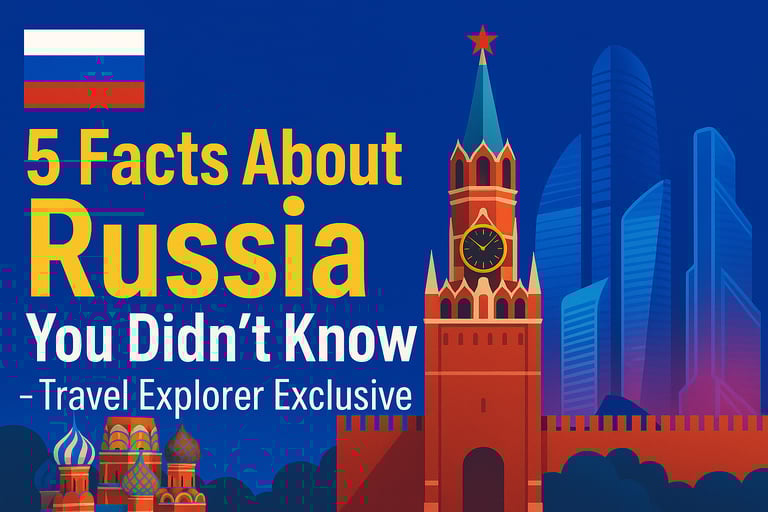
5 Fascinating Facts About Russia You Didn’t Know in 2026 – Travel Explorer Exclusive
From floating cities in Siberia to futuristic trains that cross continents, Russia in 2026 is full of wild surprises. Travel Explorer reveals 5 fascinating facts about modern Russia that will blow your mind.
EUROPE
11/6/20253 min read
Introduction: Russia, Reinvented
Russia has always been mysterious — massive, cold, and filled with stories that sound like legends. But in 2026, the country has evolved into something even more extraordinary.
It’s a nation where ancient culture meets futuristic ambition. From new Arctic cities powered by clean energy to technology shaping daily life, Russia in 2026 is rewriting its image on the global stage.
This Travel Explorer Exclusive uncovers five amazing facts about modern Russia that most travelers have never heard of — a side of the country that’s bold, creative, and completely unexpected.
1. Russia Built a Floating Arctic City 🧊
Yes, it’s real — Russia’s first floating city, “Arktika One,” officially launched in 2025 and is fully operational in 2026.
Located along the northern coast near Murmansk, this futuristic city floats on the Arctic waters and runs entirely on renewable energy. It’s built to withstand extreme temperatures, complete with solar domes, desalination plants, and vertical greenhouses.
Tourists can stay in eco-pods overlooking icy seas and experience 24-hour daylight during summer months. The city was designed not just as a housing project but as a symbol of Russia’s new Arctic development strategy, combining sustainability, research, and tourism.
It’s like visiting a sci-fi movie — except you’re in the real Arctic.
2. Russia’s Train Network Now Connects Asia and Europe in Record Time 🚄
Trains have always been part of Russia’s soul — but in 2026, they’re faster, smarter, and greener than ever.
The legendary Trans-Siberian Railway has been upgraded with a new HyperLoop-style MagRail system connecting Moscow to Vladivostok in just 11 hours instead of seven days.
This next-gen train uses magnetic levitation and AI route control to glide across Siberia at speeds over 1,000 km/h. Passengers enjoy luxury pods, augmented-reality windows, and onboard dining inspired by Russian cuisine.
For travelers, this means one thing — you can now explore the world’s largest country in a single day. It’s the future of travel, and Russia’s already living it.
3. Russia Is a Global Leader in Space Tourism 🚀
While most people think of Russia’s space legacy as something from the Cold War, in 2026 it’s leading a new race — space tourism.
Roscosmos, the Russian space agency, has partnered with private companies to offer suborbital space flights for tourists from Moscow’s “Starport Terminal.” The flights take passengers 100 kilometers above Earth for a 15-minute view of space and the curve of the planet.
Even crazier? Russia’s planning a space hotel named “Orbital Dawn,” scheduled to open in 2027. Guests will orbit Earth for five days, complete with zero-gravity dining and panoramic windows overlooking continents.
If you thought St. Petersburg was breathtaking, wait till you see it from orbit.
4. Russian Cities Are Blending History With AI 🏙️
From Moscow to Kazan, Russia’s biggest cities are becoming intelligent ecosystems powered by AI and smart data systems.
In 2026, Moscow introduced AI traffic lights, facial-recognition payment systems, and eco drones that monitor pollution and waste management. Historical districts now feature interactive “living museums” that use holograms and augmented reality to bring Tsarist-era streets to life.
Walk through Red Square, and your phone can project holographic guides explaining each monument in real time. In St. Petersburg, “Neva Vision,” an AI city assistant, helps tourists plan routes, find cultural sites, and even translate local slang instantly.
Russia’s using AI not to replace its culture — but to amplify it.
5. Russia’s Food Scene Is a Mix of Tradition and Tech 🍲
Russia’s cuisine in 2026 is having a serious glow-up. Classic dishes like borscht and pelmeni are being reimagined with a futuristic twist — think plant-based caviar, AI-paired flavor menus, and space-inspired desserts.
In Moscow and Sochi, AI chefs are now part of high-end restaurants. These digital assistants analyze millions of flavor combinations and help chefs design unique recipes based on seasonal ingredients and guest preferences.
Meanwhile, rural Siberia has turned into a farm-to-table paradise. Organic farms and eco-lodges now invite travelers to harvest, cook, and dine with locals — offering authentic experiences away from the tourist buzz.
Russia’s food culture today blends comfort and creativity — traditional soul with a 21st-century upgrade.
Travel Explorer Takeaway 🌏
Russia in 2026 isn’t just a country — it’s a journey through time. It’s where medieval cathedrals meet magnetic trains, Arctic waves cradle floating cities, and centuries-old recipes are reborn with technology.
Whether you’re an adventurer chasing the Northern Lights or a traveler curious about innovation, modern Russia is full of stories waiting to be discovered.
It’s not the Russia from textbooks — it’s the Russia of tomorrow.
© 2026. All rights reserved.