
Antarctica Citizenship & Passport 2026: Can You Own or Live on the Frozen Continent?
Can anyone own Antarctica, get citizenship, or hold an Antarctica passport in 2026? This Travel Explorer guide explains Antarctic ownership laws, citizenship myths, passports, territorial claims, and what international treaties actually allow—clearly and legally.
ANTARCTICA
12/29/20253 min read
Introduction: Why People Ask About Antarctica Citizenship
Every year, thousands of people search for one question that sounds simple but is legally complex:
Can anyone own Antarctica or get citizenship and a passport in 2026?
The curiosity is understandable. Antarctica is the only continent without native people, governments, cities, or borders. It feels like a blank slate—untouched land where traditional rules may not apply.
However, the reality is far stricter than the myth. Antarctica is not lawless, ownerless, or open for citizenship in the way many imagine.
This Travel Explorer guide explains the full truth—legally, historically, and practically—about ownership, citizenship, and passports related to Antarctica in 2026.
What Is Antarctica From a Legal Perspective?
Antarctica is not a country, a territory for sale, or a future nation waiting to be claimed.
Instead, Antarctica is:
A globally protected scientific preserve
Governed collectively by international agreement
Dedicated to peace and research
No constitution exists. No immigration office exists. No citizenship registry exists.
Can Anyone Own Antarctica in 2026?
The Short Answer
No. Nobody—individuals, companies, or countries—can own Antarctica.
Why Ownership Is Impossible
Antarctica is governed by the Antarctic Treaty System, first signed in 1959 and still fully active in 2026. The treaty clearly states:
No new sovereignty claims are allowed
Existing territorial claims are frozen
No private ownership or land purchase is valid
Military activity is prohibited
The continent is reserved for peaceful scientific use
This means:
You cannot buy land
You cannot inherit land
You cannot claim land by settlement
You cannot build permanent private property
Any online listing claiming to sell Antarctic land is legally meaningless.
What About Countries That “Claim” Antarctica?
Historical Claims Explained
Seven countries historically claimed sections of Antarctica:
Argentina
Australia
Chile
France
New Zealand
Norway
United Kingdom
However, these claims are:
Not internationally recognized as ownership
Frozen under the treaty
Cannot be expanded, enforced, or sold
Even these countries cannot grant citizenship or land rights in Antarctica.
Can a Person Become a Citizen of Antarctica?
Citizenship Requires a Country
Citizenship is a legal status granted by a sovereign state. Antarctica is not a sovereign state.
Therefore:
There is no Antarctic citizenship
There is no Antarctic nationality
There is no permanent resident status
In 2026, this remains unchanged.
What About People Who Live in Antarctica?
Scientists and Researchers
Yes, people live in Antarctica temporarily. But they remain citizens of their home countries.
Examples:
A scientist from India remains an Indian citizen
A researcher from the USA remains an American citizen
A technician from Germany remains German
Their presence in Antarctica is:
Temporary
Purpose-based
Not immigration
When their assignment ends, they must leave.
Is There an Antarctica Passport?
The Passport Myth Explained
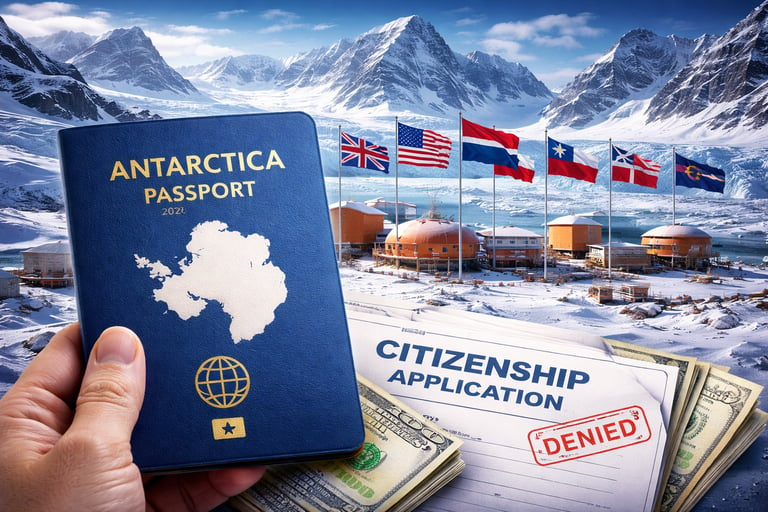
There is no official Antarctica passport.
Any passport you see online claiming to be from Antarctica is:
A novelty item
A souvenir
A symbolic document with no legal value
It cannot be used for:
International travel
Immigration
Identification
Visa-free entry
Airlines, border agencies, and embassies do not recognize it.
Why Can’t Antarctica Create Citizenship in the Future?
Structural Barriers
Even in 2026, creating citizenship would require:
A recognized government
A constitution
A legal population
A defined territory
Antarctica intentionally lacks all four.
The Antarctic Treaty makes it extremely unlikely that Antarctica will ever become a country.
Can Someone Renounce Their Citizenship and Live Only in Antarctica?
No.
International law does not allow stateless permanent residence in Antarctica. Every person on the continent must:
Be sponsored by a treaty nation
Hold valid citizenship elsewhere
Have a purpose (science, logistics, tourism)
Permanent self-settlement is illegal.
What Happens If Someone Tries to Claim Antarctica Personally?
Any attempt to:
Declare independence
Create a micronation
Sell land
Issue passports
Is legally void and ignored by international law.
In practice:
Logistics access would be denied
Rescue services would not support illegal settlements
Governments would intervene if safety risks arise
Can Antarctica Ever Become a Country?
Realistically, No
Antarctica serves a unique global role:
Climate research
Space and atmospheric studies
Wildlife protection
Global cooperation symbol
Turning it into a country would:
Destroy treaty stability
Create geopolitical conflict
Threaten fragile ecosystems
As of 2026, all major powers support keeping Antarctica neutral and non-sovereign.
Why Antarctica Is Different From Every Other Continent
Antarctica is:
The coldest continent
The driest continent
The least populated continent
The only continent without citizenship
This uniqueness is intentional, not accidental.
Common Myths About Antarctica Citizenship
Myth 1: You Can Be Born There and Get Citizenship
False. Citizenship follows parents’ nationality.
Myth 2: Rich People Can Buy Antarctic Land
False. No ownership exists.
Myth 3: Antarctica Has Hidden Citizenship Programs
False. No such programs exist.
Myth 4: Antarctica Will Open Immigration in the Future
Highly unlikely and opposed by treaty members.
What You Can Do Legally in Antarctica
Although you cannot own Antarctica or get citizenship, you can:
Visit as a tourist
Work as a scientist or support staff
Participate in research missions
Experience extended stays under authorization
Your legal identity, however, remains tied to your home country.
Why This Question Will Keep Being Asked
The idea of Antarctica represents:
Freedom from borders
Escape from governments
A fresh start
But in reality, Antarctica is protected precisely because humanity agreed not to exploit it.
Travel Explorer Final Verdict (2026)
Can Anyone Own Antarctica?
No.
Can Anyone Get Antarctica Citizenship?
No.
Is There an Antarctica Passport?
No.
Will This Change Soon?
Extremely unlikely.
Conclusion: Antarctica Belongs to No One—and Everyone
Antarctica is humanity’s rarest achievement: a continent preserved not for profit or power, but for knowledge and peace.
In 2026, it remains:
Unowned
Uncitizened
Uncommercialized
And that is exactly why it matters.
If you want to experience Antarctica, you must do so as a guest of the world, not as an owner or citizen.
That is the full and honest Travel Explorer truth.
© 2026. All rights reserved.