
Can Muslims Really Visit Israel? The Surprising Truth Most People Don’t Know
Many people believe Muslims are completely banned from traveling to Israel. But the reality is far more surprising. Thousands of Muslims visit every year, especially to pray at Al-Aqsa Mosque in Jerusalem. So what is the real rule, and why are so many people confused about it?
ASIA
3/9/20264 min read
The Question That Confuses Millions: Can Muslims Travel to Israel?
Every year, millions of people search online trying to find a clear answer to one controversial question.
Can Muslims travel to Israel?
Some believe the answer is an absolute no.
Others claim Muslims visit Israel every year.
The confusion comes from a mixture of politics, religion, and international travel rules.
Because of decades of political tensions in the Middle East, many people assume that Muslim travelers are completely banned from entering Israel.
But the real situation is much more complex—and much more surprising.
In reality, thousands of Muslim travelers visit Israel every year for religious pilgrimage, tourism, journalism, and business.
To understand how this works, we need to look at religion, politics, and travel laws together.
Why Many Muslims Dream of Visiting Jerusalem
For Muslims around the world, the city of Jerusalem holds enormous spiritual importance.
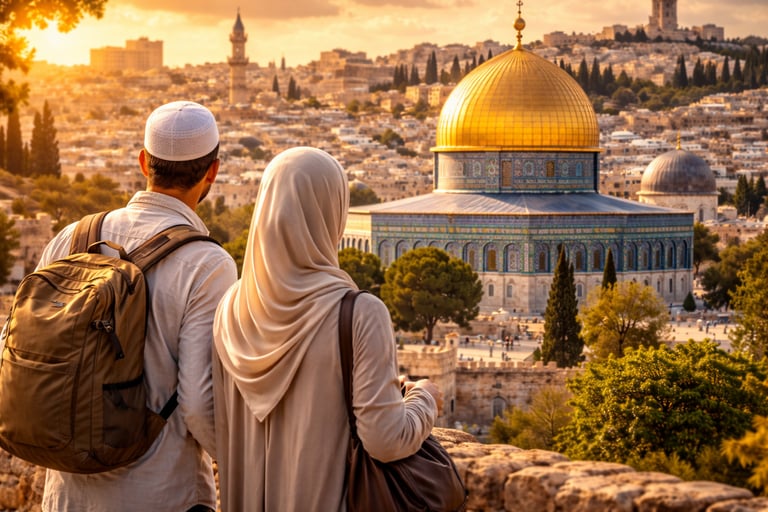
Inside Jerusalem is one of the holiest places in Islam: Al-Aqsa Mosque.
Al-Aqsa Mosque is considered the third holiest site in Islam, after:
Masjid al-Haram in Mecca
Al-Masjid an-Nabawi in Medina
Because of its religious importance, millions of Muslims across the world hope to visit Al-Aqsa Mosque at least once in their lifetime.
For many believers, praying there carries deep spiritual meaning and historical significance.
This is why the question of whether Muslims can travel to Israel attracts so much attention.
The Simple Truth: Muslims Are Not Banned From Israel
One of the biggest myths circulating online is that Muslims are banned from entering Israel.
This is not true.
Israel does not ban travelers based on religion.
Muslims from many countries travel to Israel every year.
These visitors include:
religious pilgrims
tourists
journalists
business travelers
students
Many Muslim travelers enter Israel specifically to visit Jerusalem and pray at Al-Aqsa Mosque.
However, the process of traveling there can sometimes be complicated.
The Real Factor That Determines Travel
Whether someone can easily travel to Israel depends mostly on their passport, not their religion.
Travel rules vary depending on which country issued the traveler’s passport.
Citizens of countries that have diplomatic relations with Israel usually have fewer travel difficulties.
In recent years, some Middle Eastern countries have normalized relations with Israel, making travel easier for their citizens.
But travelers from countries that do not have diplomatic relations with Israel may face stricter visa requirements or additional security checks.
Even in those cases, travel is often still possible with proper documentation.
Why So Many People Think Muslims Cannot Visit
The belief that Muslims cannot travel to Israel mainly comes from political tensions in the region.
For decades, many Muslim-majority countries did not maintain diplomatic relations with Israel.
Because of this, direct travel between those countries and Israel was extremely limited.
In some cases, citizens of certain countries were discouraged or even restricted by their own governments from visiting Israel.
These political restrictions created the widespread belief that Muslim travelers themselves were banned.
But the reality is that Israel’s entry policies focus on nationality and security checks, not religion.
The Spiritual Importance of Al-Aqsa Mosque
For Muslims, Al-Aqsa Mosque is far more than just a historic building.
According to Islamic tradition, it is connected to one of the most important spiritual events in Islam known as Isra and Mi'raj.
During this miraculous journey, the Prophet Muhammad is believed to have traveled from Mecca to Jerusalem and then ascended to the heavens.
Because of this event, Al-Aqsa Mosque has remained one of Islam’s most sacred locations for centuries.
Muslim pilgrims from many parts of the world travel long distances just to pray there.
For many believers, visiting Al-Aqsa is a deeply emotional and spiritual experience.
Muslims Already Living Inside Israel
Another fact that many people do not realize is that millions of Muslims already live inside Israel.
These Muslim citizens and residents form a significant part of the country’s population.
They live in cities, towns, and villages across the region.
Many of them regularly travel to Jerusalem to pray at Al-Aqsa Mosque.
Islam has existed in the region for centuries, and many historic mosques and Islamic communities remain active there today.
This often surprises people who assume Israel is exclusively connected to only one religion.
Security Checks and Travel Screening
Although Muslims can travel to Israel, the journey may involve strict security procedures.
Israel has some of the most detailed airport and border security checks in the world.
Travelers may be asked detailed questions about their travel plans, accommodation, and background.
This process can take longer than in many other countries.
However, these procedures apply to travelers of many nationalities and backgrounds.
They are primarily related to security policies rather than religious identity.
Why Muslim Tourism Still Continues
Despite political tensions and complicated travel rules, Muslim tourism to Jerusalem continues every year.
Religious pilgrims, scholars, and tourists continue to visit Al-Aqsa Mosque.
Many Muslim travelers describe the experience as one of the most meaningful journeys of their lives.
Walking through the historic streets of the Old City, hearing the call to prayer echo through ancient stone walls, and standing inside one of Islam’s holiest sites creates a powerful connection to history and faith.
A Journey Through One of the World’s Most Historic Cities
Jerusalem is one of the oldest continuously inhabited cities in the world.
For thousands of years, it has been a center of religion, culture, and history.
The city contains sacred sites important to three major religions.
Muslim visitors often explore:
Al-Aqsa Mosque
the historic Old City markets
centuries-old Islamic schools and architecture
For many travelers, visiting Jerusalem feels like stepping into a living history book.
The Final Answer
So can Muslims travel to Israel?
Yes, they can.
Religion itself is not a barrier to entry.
However, travel conditions depend heavily on nationality, visa rules, and political circumstances.
Despite the confusion surrounding the issue, thousands of Muslim visitors continue to travel to Jerusalem every year to experience one of the most sacred places in Islam.
And for many of them, the moment they step inside Al-Aqsa Mosque becomes a memory they carry for the rest of their lives.
© 2026. All rights reserved.