Countries Secretly Owned by Private People — You Won’t Believe These Places Actually Exist
Did you know some countries and territories around the world are controlled by private individuals? Discover the most fascinating privately owned countries, micronations, and independent territories that actually exist.
3/15/20264 min read
Countries Owned by Private Individuals
Most people assume that every country in the world is controlled by a government.
Presidents, kings, or elected leaders usually run nations, while citizens follow national laws and institutions.
But history shows something far more unusual.
There are places in the world where private individuals have created or controlled their own nations. These territories may have their own flags, currencies, governments, and even passports.
Some of them were created as political protests.
Some started as experiments in freedom and governance.
Others were simply founded by people who believed they had the right to build their own country.
Although most of these places are not officially recognized by international organizations, many of them operate with structures that resemble real nations.
Here are some of the most fascinating examples of countries or territories that have been privately created or controlled.
The Principality of Sealand
One of the most famous privately controlled territories in the world is the Principality of Sealand.
This small territory sits on an abandoned sea fort in the North Sea, located several kilometers off the coast of the United Kingdom.
The story began in 1967 when a British entrepreneur named Paddy Roy Bates occupied the abandoned World War II fort known as Roughs Tower.
Instead of simply living there, he declared the structure an independent country.
He proclaimed himself Prince Roy of Sealand and created many elements normally associated with a nation.
Sealand eventually developed:
a national flag
a constitution
its own passports
national currency
a royal family
The platform even experienced an attempted takeover in the 1970s by a group of businessmen who tried to seize control of the territory.
Despite the unusual circumstances, Sealand has continued operating for decades and remains one of the most well-known privately founded countries in the world.
The Principality of Hutt River
Another remarkable example existed in Western Australia for nearly half a century.
The Principality of Hutt River was founded by Leonard Casley in 1970.
Casley was a farmer who had a dispute with the Australian government over wheat production quotas.
Instead of accepting the regulation, he declared his farm an independent nation and proclaimed himself Prince Leonard.
The territory began operating as a micronation with many symbols of statehood.
Hutt River introduced:
its own currency
national stamps
passports
government offices
Tourists from around the world visited the principality to experience what felt like entering a separate country within Australia.
The micronation survived for almost fifty years before it officially dissolved in 2020 due to legal and financial pressures.
Even though it no longer exists as an independent entity, Hutt River remains one of the most famous privately declared countries in modern history.
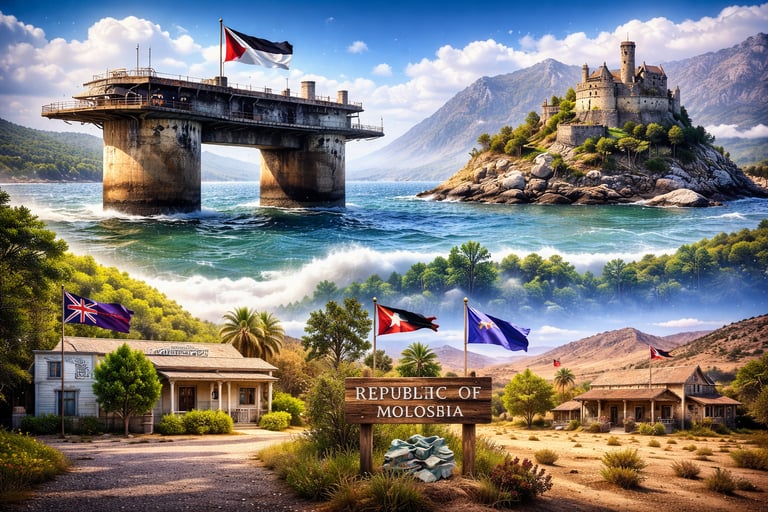
The Republic of Molossia
In the Nevada desert in the United States lies a tiny territory that calls itself the Republic of Molossia.
The country was founded by Kevin Baugh, who declared his private property to be an independent republic.
Molossia has built an elaborate national identity that includes many features normally associated with sovereign nations.
The territory includes:
a national flag
a government structure
a national bank
its own currency
border checkpoints
Visitors are sometimes allowed to tour the small territory and even receive passport stamps.
Molossia also maintains humorous traditions, including a fictional ongoing conflict with East Germany.
While the micronation is largely symbolic, it has gained worldwide attention for its creativity and unusual political experiment.
Liberland
Liberland is one of the most ambitious attempts to create a new country in modern times.
In 2015 Czech politician Vít Jedlička announced the creation of a new nation on a piece of land located between Croatia and Serbia along the Danube River.
The territory existed because of a border dispute between the two countries, leaving the land effectively unclaimed.
Seeing an opportunity, Jedlička declared the establishment of Liberland.
The proposed country promotes ideas of minimal government, voluntary participation, and economic freedom.
Within days of its announcement, hundreds of thousands of people from around the world applied for citizenship.
Liberland now has:
a national flag
a constitution
digital citizenship applications
a government structure
However, Croatia controls access to the land, which has prevented permanent settlement so far.
Despite this challenge, the project continues attracting global attention.
The Kingdom of Tavolara
The small island of Tavolara located near Sardinia in Italy has one of the most unusual royal histories in Europe.
In the nineteenth century a man named Giuseppe Bertoleoni claimed the island and declared himself king.
According to historical accounts, his claim was later acknowledged by the King of Italy.
For many years the Bertoleoni family ruled Tavolara as a tiny island kingdom.
Although the island eventually became part of Italy, the family continues to maintain the royal heritage and history associated with the island.
Visitors to Tavolara can still hear stories about the unusual royal lineage connected to the island.
Freetown Christiania
In Copenhagen, Denmark, there is a district known as Freetown Christiania that operates very differently from the rest of the country.
The community was established in 1971 when artists and activists occupied an abandoned military area.
Residents developed a self-governing community with its own internal rules and social structure.
Christiania became known for its alternative lifestyle, creative culture, and collective decision-making system.
The area operates with a high degree of autonomy even though it remains officially part of Denmark.
Christiania has become one of Europe’s most famous experimental communities.
Why People Try to Create Their Own Countries
The idea of founding a country may sound unrealistic, but history shows that people have attempted it many times.
Some founders were protesting government policies.
Others wanted to create societies based on different political or economic ideas.
In many cases, these micronations function as symbolic projects that explore new ideas about freedom, governance, and independence.
They also capture the imagination of people who wonder whether individuals can create entirely new nations.
The Future of Privately Created Nations
With the rise of digital technology, new forms of nations are beginning to appear.
Some projects focus on digital citizenship communities.
Others explore ideas like floating cities or decentralized governance systems.
While most privately created countries will never receive international recognition, they still represent fascinating experiments in political creativity.
They challenge the traditional idea that only governments can create and control nations.
Final Thoughts
The world is full of unusual stories that most people never learn in school.
Privately created countries are one of those fascinating realities.
From sea platforms in the North Sea to desert micronations in Nevada, these territories show how determined individuals have tried to build their own nations.
Some lasted decades.
Some became global curiosities.
Others continue operating today as unique social experiments.
Whether symbolic or serious, these privately founded countries reveal something surprising about the modern world.
The idea of a nation is not always as fixed as we think.
© 2026. All rights reserved.