
Country With the Weakest Passport in 2026: What It Means for Travel Freedom | Travel Explorer
Country With the Weakest Passport in 2026? Discover the harsh travel realities, visa barriers, and global mobility limits faced by holders of the world’s weakest passport. An in-depth Travel Explorer analysis.
ASIA
1/16/20263 min read
Introduction: Why Passport Power Matters More Than Ever in 2026
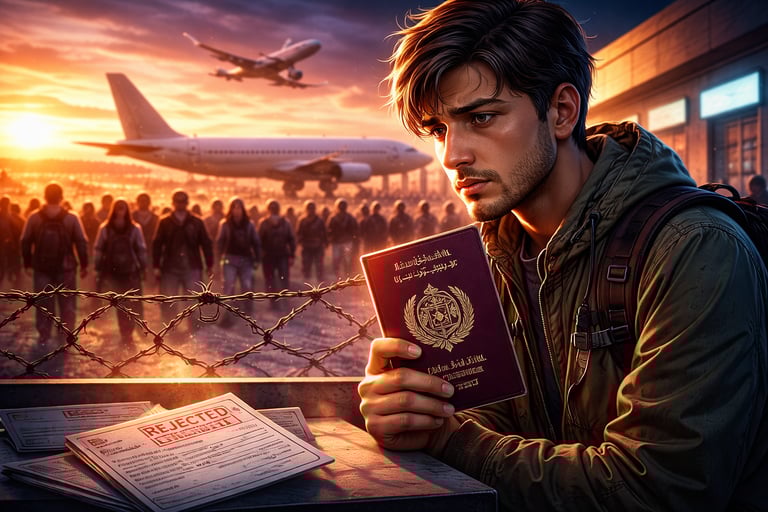
In 2026, a passport is no longer just a travel document. It is a measure of global trust, political stability, economic integration, and diplomatic influence. While citizens of some countries can cross borders with ease, others face intense scrutiny, repeated rejections, and humiliating visa processes—often before they even step into an airport.
The concept of a “weak passport” is not theoretical. It has real consequences: lost opportunities, restricted education, limited medical travel, blocked employment options, and psychological isolation from the rest of the world.
In 2026, one country consistently stands at the bottom of global mobility rankings, symbolizing what it means to be born into restricted movement.
That country is Afghanistan.
What Does “Weakest Passport” Actually Mean?
A weak passport is defined by one core metric: how many countries its holder can enter without a visa, or with visa-on-arrival access.
In 2026, passport strength determines:
How easily a person can travel for tourism
Whether they can attend international conferences
If they can pursue overseas education
How fast they can escape emergencies
Whether airlines even allow them to board
For holders of the weakest passports, travel is not a right—it is an exhausting negotiation.
Afghanistan’s Passport in 2026: The Global Reality
In 2026, Afghanistan’s passport remains the weakest in the world by a wide margin.
Afghan passport holders can travel visa-free or with visa-on-arrival access to fewer than 30 countries, most of which are either politically unstable, geographically isolated, or difficult to reach logistically.
Even those limited destinations often impose:
Extra documentation
Manual immigration approval
Long border interrogations
Arbitrary entry denial
For most of the world, Afghanistan’s passport is treated as a high-risk travel document.
Why Afghanistan’s Passport Is the Weakest
Political Instability and Global Trust Deficit
Passport strength is not about citizens—it is about how much other nations trust the issuing state.
Years of political upheaval, governance instability, and international sanctions have severely damaged Afghanistan’s diplomatic credibility. Immigration authorities evaluate passports as risk profiles, and Afghanistan scores extremely poorly in that assessment.
Security Perceptions and Border Risk
In 2026, global border security systems heavily rely on predictive risk modeling. Unfortunately, Afghan passport holders are often flagged automatically, regardless of personal background.
This results in:
Secondary inspections
Frequent visa refusals
Airline denials before boarding
Long-term travel history scrutiny
This systemic distrust is structural, not personal.
Lack of Bilateral Visa Agreements
Passport power depends on bilateral agreements. Afghanistan has very few active visa waiver or facilitation agreements, which severely limits mobility.
Other countries actively negotiate visa-free access. Afghanistan, due to geopolitical isolation, does not.
What Travel Looks Like for Afghan Passport Holders
Traveling with one of the world’s weakest passports is an entirely different experience.
The Visa Application Cycle
An Afghan traveler typically faces:
High visa fees
Non-refundable rejections
Months-long processing times
Excessive financial proof requirements
Personal interviews that feel like interrogations
A single rejected visa can block future applications across multiple countries.
Airline and Transit Problems
Even when a visa is approved, transit through major hubs is often denied. Many airlines avoid carrying passengers with Afghan passports due to compliance risks.
This forces travelers into:
Expensive indirect routes
Unreliable connections
Additional transit visas
Travel becomes financially and emotionally exhausting.
Comparison With Other Weak Passports in 2026
While Afghanistan ranks at the bottom, other countries also struggle with weak passport access.
Countries such as Syria, Iraq, Yemen, and Pakistan also face significant travel restrictions.
However, even among these, Afghanistan remains uniquely disadvantaged due to the combination of sanctions, lack of diplomatic recognition, and limited international engagement.
The Human Cost of a Weak Passport
A weak passport does not only restrict tourism. It affects every dimension of life.
Education Barriers
Students struggle to obtain visas for universities abroad, even with full scholarships. Many offers are lost simply due to visa refusals.
Medical Travel Limitations
Access to advanced healthcare abroad becomes nearly impossible. Emergency medical travel is often delayed beyond usefulness.
Career and Business Isolation
Global careers, international conferences, and overseas entrepreneurship are largely inaccessible.
Talent is trapped behind borders.
Can Passport Strength Improve Over Time?
Yes—but not quickly.
Passport power improves through:
Political stabilization
International recognition
Trade agreements
Diplomatic normalization
Security cooperation
Unfortunately, these are long-term processes measured in decades, not years.
In 2026, meaningful improvement remains unlikely in the short term.
Dual Citizenship and Legal Workarounds
Some individuals attempt to escape weak passport limitations through:
Legal migration
Investment residency programs
Marriage-based citizenship
Refugee resettlement pathways
However, these options are available only to a tiny fraction of the population and involve immense legal and financial complexity.
For most citizens, the passport they are born with defines their mobility for life.
Passport Inequality: The Global Travel Apartheid
Passport strength in 2026 highlights a harsh truth: global mobility is unequal by birth.
Two people with identical talent, ambition, and intelligence can experience completely different lives simply because of the passport they carry.
This invisible inequality is one of the least discussed but most powerful forces shaping global opportunity.
Why Travelers Should Understand Passport Power
Understanding passport strength is essential for:
Global travelers
Digital nomads
Immigration planners
Policy analysts
Human rights observers
It explains why borders are not equally open—and never have been.
Final Verdict: The Weakest Passport in 2026
In 2026, Afghanistan holds the weakest passport in the world, offering its citizens the least travel freedom, highest visa rejection rates, and most restrictive border treatment.
This reality is not a reflection of its people—but of geopolitics, security perceptions, and global inequality.
Until systemic change occurs, millions remain effectively grounded by the document they carry.

© 2026. All rights reserved.