
He Went To North Korea For Fun And Never Came Back Alive – The Shocking Story Of Otto Warmbier
A 22-year-old American tourist entered North Korea for a short trip. Months later, he returned home in a coma and died within days. Here’s the disturbing, emotional, and controversial story of Otto Warmbier.
ASIA
2/19/20263 min read
A Curious Student with a Bright Future
In January 2016, Otto Warmbier was a 21-year-old University of Virginia student. Smart, ambitious, and globally curious, he decided to visit North Korea.
The trip was arranged through a travel company that specialized in guided tours into the highly restricted country. The itinerary included monuments, state-approved cultural visits, and New Year’s celebrations in Pyongyang.
It was supposed to be a short adventure.
It became an international tragedy.
Tourism Inside a Controlled System
North Korea operates under strict authoritarian control led by Kim Jong-un. Tourism is permitted, but only under intense supervision.
Visitors must:
Stay with assigned guides at all times
Follow rigid photography rules
Avoid political discussion
Show visible respect to leadership images and monuments
The legal system offers little transparency, and penalties can be severe. Foreign nationals operate entirely within the authority of the state.
The Arrest at the Airport
On January 2, 2016, as Otto Warmbier prepared to depart Pyongyang International Airport, he was detained.
Authorities accused him of attempting to remove a political propaganda poster from a restricted area in his hotel.
State media later released surveillance footage, though the images were unclear. Despite limited publicly verifiable evidence, he was charged with committing a “hostile act against the state.”
The alleged offense involved a poster.
The consequences would be devastating.
The Televised Confession
In February 2016, Warmbier appeared before international media in a North Korean press event. He delivered a tearful confession, apologizing and claiming he was influenced by others to commit the act.
Observers widely questioned whether the confession was voluntary.
Shortly afterward, he was sentenced to 15 years of hard labor.
He was 21 years old.
17 Months Without Public Updates
Following sentencing, Warmbier was not seen publicly again for more than a year.
The U.S. government attempted diplomatic engagement through limited communication channels, but relations between Washington and Pyongyang were strained.
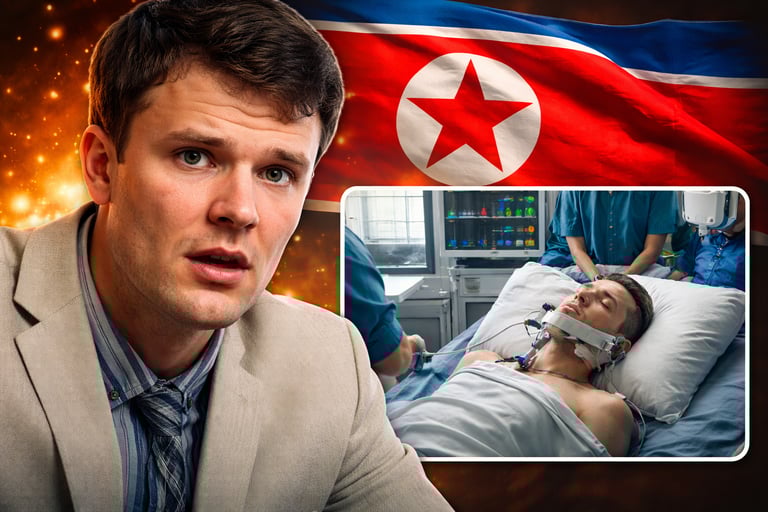
Then, in June 2017, North Korea announced that Warmbier had been in a coma for over a year.
The Medical Explanation
North Korean officials claimed he contracted botulism and took a sleeping pill, after which he fell into a coma.
American doctors later found no clear evidence of botulism.
After 17 months in detention, Warmbier was released and transported back to the United States on a medical evacuation flight.
He arrived unresponsive.
Findings in the United States
Upon arrival in Cincinnati, physicians determined that he had suffered severe neurological damage consistent with prolonged oxygen deprivation.
He showed no awareness of surroundings and never regained consciousness.
There were no widely reported signs of conventional physical trauma, but the brain injury was catastrophic.
Six days after returning home, Otto Warmbier died at the age of 22.
Diplomatic and Legal Fallout
The incident intensified tensions between the United States and North Korea.
Then U.S. President Donald Trump publicly criticized the North Korean government following Warmbier’s death.
Shortly thereafter, the United States re-designated North Korea as a state sponsor of terrorism.
In 2018, a U.S. federal court awarded the Warmbier family more than $500 million in damages in a wrongful death lawsuit against North Korea. Collecting such damages remains legally complex.
What Remains Uncertain
The precise cause of Warmbier’s brain injury has never been conclusively established.
North Korea maintains that illness was responsible.
Medical experts in the United States found inconsistencies with that explanation.
Due to the lack of transparent access to medical records and detention conditions, definitive answers remain unavailable.
Impact on Travel Policy
After this case, the U.S. government imposed a travel restriction prohibiting most American citizens from visiting North Korea without special authorization.
The tragedy became a reference point in discussions about the risks of travel in tightly controlled political systems.
It highlighted how dramatically legal protections can vary across borders.
Human Cost Beyond Politics
Beyond geopolitics and policy, the story centers on a young man and his family.
Warmbier left home for what he believed would be a short international experience.
He returned gravely injured.
His parents later described the emotional shock of seeing their son in an unresponsive state.
The loss was personal before it was political.
Lessons for International Travelers
Warmbier’s case underscores several practical realities:
Legal systems differ fundamentally across countries.
Foreign nationals may have limited consular protection in hostile environments.
Seemingly minor actions can carry disproportionate consequences under authoritarian governance.
Transparency and due process are not universal guarantees.
Understanding political context is critical when choosing travel destinations.
Final Reflection
Otto Warmbier’s journey began as a five-day guided trip.
It ended in prolonged detention, irreversible brain injury, and death at 22.
His case altered diplomatic relations, reshaped travel restrictions, and continues to be discussed as one of the most disturbing modern travel tragedies.
A short vacation turned into a lasting international incident — and a reminder that global travel sometimes intersects with forces far beyond a tourist’s control.
© 2026. All rights reserved.