How to Find $1 Local Food in Any Country in 2026 — Practical Hacks and Street Dining Tips by Travel Explorer
Learn how to find delicious $1 local food in any country in 2026. Discover street food tricks, market navigation, cultural cues, and budget travel habits with guidance inspired by Travel Explorer.
11/23/20253 min read
How to Find $1 Local Food in Any Country in 2026 — Complete Travel Explorer Style Guide
Traveling in 2026 has become easier, smarter, and more connected, yet one thing remains timeless — the joy of discovering cheap, authentic local food. Many travelers still believe that eating abroad must be expensive, especially with global inflation and rising tourism prices. But the truth is simple:
There is always a way to eat for $1 if you know where to look.
Whether you're traveling through Asia, Europe, Africa, the Middle East, North America, or South America, the secret to budget-friendly food lies in understanding how locals eat, where crowds gather, and how traditional food economies still operate outside tourist zones.
This guide will teach you how to find $1 meals anywhere in the world using cultural awareness, street market intuition, practical travel behaviors, observation techniques, and spending habits inspired by the spirit of Travel Explorer.
Why $1 Food Still Exists in 2026
Even in cities where food prices have increased, $1 meals remain available because:
✅ Local working-class communities rely on cheap food
✅ Street vendors compete through price
✅ Traditional markets follow older pricing structures
✅ Cultural dishes are designed to be affordable
✅ Many foods use simple, low-cost ingredients
Tourist areas create the illusion that cheap food is gone. Move one block away, and the real local economy appears.
Understanding the Difference Between Tourist Food and Local Food
To find $1 meals, you must distinguish:
Tourist Food
high markup
English menus
decorated storefronts
card payment
trendy visuals
Local Food
handwritten signs
basic seating
cash-based
workers eating there
authentic recipes
Travel Explorer style travel always emphasizes the neighborhood mindset — not the sightseeing bubble.
Where to Look for $1 Food in Any Country
1. Street Food Alleys and Hawker Clusters
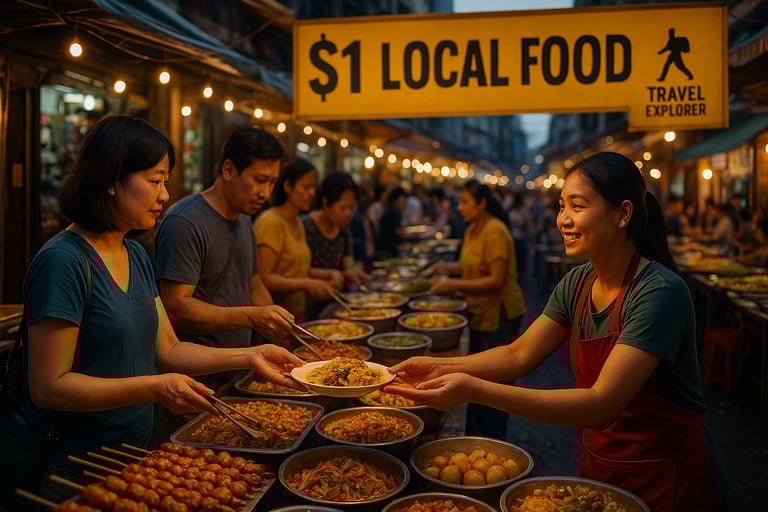
Every country has outdoor eating areas where vendors specialize in:
noodles
flatbreads
stews
rice bowls
dumplings
filled pastries
These places maintain low prices because locals demand affordability.
2. Morning Markets
Breakfast food is always the cheapest meal of the day.
You can find:
porridge
tea snacks
buns and breads
boiled eggs
fried dough
fruit portions
Morning food culture thrives in every region, making it the easiest $1 meal option.
3. Bus and Train Station Food Stalls
Transport hubs cater to travelers, workers, and drivers — not tourists.
Expect:
fast service
filling carbs
inexpensive portions
Travel Explorer often notes that transportation zones are hidden food districts.
4. University Districts
Students eat cheaply everywhere in the world.
Look for:
cafeteria-style diners
quick snack counters
noodle bars
sandwich stalls
Student neighborhoods are global havens for $1 snacks and meals.
5. Worker Lunch Zones
Construction workers, factory staff, and delivery riders eat at places designed for affordability.
If you see uniforms — you’re in the right place.
6. Bakeries and Fresh Bread Shops
Bread-based diets make snacking extremely cheap.
Examples include:
flatbreads
rolls
stuffed pastries
day-old racks
Carbs are always priced low because they are staple foods.
7. Local Grocery Chains with Prepared Items
In many countries, supermarkets offer:
rice boxes
dumplings
sushi singles
salad cups
rotisserie scraps
These options help travelers stay full on minimal cost.
How to Identify $1 Food Without Asking
Use your senses like a Travel Explorer.
Look for:
✅ crowds
✅ turnover
✅ steam and smoke
✅ handwritten signs
✅ trays with repeating items
Avoid:
❌ empty shops
❌ menus with photos
❌ multi-language displays
Locals guide you without speaking.
Cultural Clues That Lead to Cheap Food
Asian countries
Street noodles, buns, fried snacks
Middle Eastern regions
Bread, falafel, rice-based plates
European countries
Bakery pastries, market soups
Africa
Starchy bases, skewers, street stews
South America
Empanadas, arepas, rice and bean plates
North America
Ethnic districts, dollar-slice pockets, taco carts
Every region has a $1 equivalent — just not in tourist packaging.
How to Avoid Tourist Pricing Traps
✅ Don’t sit down immediately
✅ Walk away from main attractions
✅ Ignore menu boards in English
✅ Don’t choose places with décor themes
The more Instagram-friendly the shop, the less friendly the price.
How to Communicate Without Language
You can order $1 food anywhere by:
pointing
observing what others buy
showing fingers for quantity
using local currency coins
smiling
Travel Explorer style travel thrives on simplicity, not fluency.
Best Times of Day for Cheap Food
Morning
Fresh and cheapest
Late Afternoon
Pre-dinner discount snacks
Near Closing
Vendors want to clear stock
Timing is a hidden money-saving tool.
How to Pay Like a Local
✅ carry small cash
✅ avoid credit cards
✅ never ask “how much?” in English
✅ watch others pay
If a vendor sees you as a visitor, price inflates.
Safety Tips While Eating Cheap
✅ choose busy stalls
✅ observe cleanliness basics
✅ avoid raw food in hot climates
✅ drink bottled or boiled liquids
Cheap doesn’t have to mean risky.
How to Stay Full on $3 a Day While Traveling
Combine:
✅ $1 breakfast
✅ $1 snack
✅ $1 meal
Travel Explorer emphasizes experiential travel, not luxury dining.
What Not to Do When Searching for $1 Food
❌ don’t judge appearances
❌ don’t expect Western flavors
❌ don’t compare prices to home
❌ don’t rush into the first option
Patience uncovers the hidden gems.
Why $1 Food Makes Travel Better
✅ more interaction
✅ more culture
✅ more authenticity
✅ more adventure
✅ more savings
Cheap food leads to richer stories.
Final Outlook
Even in 2026, the world remains filled with affordable meals. Travelers who step beyond commercial zones, follow local routines, and trust observational instincts can eat deliciously on just $1 anywhere on the planet.
Conclusion
Finding $1 food in any country in 2026 is not about luck — it's about mindset. By embracing local eating habits, identifying non-tourist food sources, paying attention to cultural food patterns, and navigating markets with confidence, travelers can eat affordably and authentically. With guidance by Travel Explorer, the journey becomes richer, more meaningful, and far more delicious — without ever breaking the budget.
© 2026. All rights reserved.