
I Visited Both North Korea and South Korea — The Difference Shocked Me More Than I Expected
I traveled to both North Korea and South Korea to see the reality with my own eyes. What I experienced in Pyongyang and Seoul completely changed how I understand these two divided nations.
ASIA
2/24/20264 min read
Two Koreas, One Peninsula — But Two Completely Different Worlds
Travel often changes your perspective. But sometimes, it completely reshapes the way you understand society.
I had the rare opportunity to visit both North Korea and South Korea. On a map, they share the same peninsula, a common language origin, and thousands of years of cultural history. In reality, they feel like two entirely separate universes.
This isn’t a political breakdown. It’s a personal, on-the-ground reflection of what I observed, felt, and learned.
Arriving in Pyongyang: Structured and Carefully Managed
Landing in Pyongyang felt like stepping into a different era.
Visitors are accompanied by assigned guides at all times. Independent exploration is not permitted. Photography has restrictions. Conversations remain formal and measured.
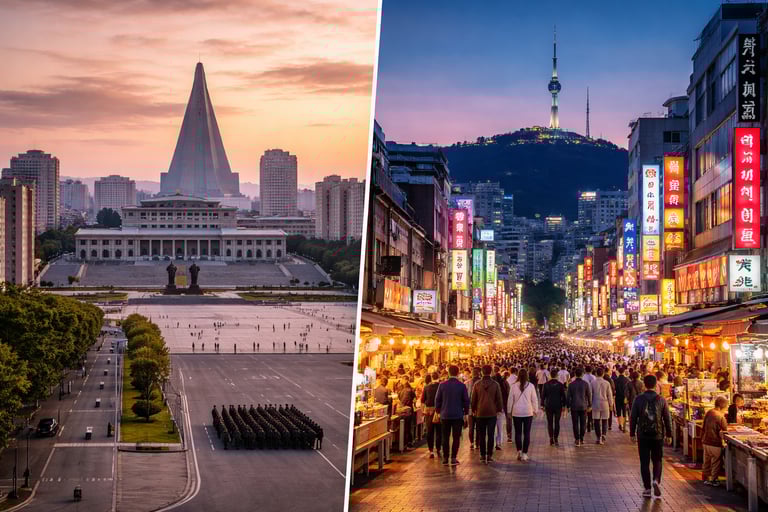
One of the first landmarks I encountered was Kim Il Sung Square — enormous, symmetrical, and clearly built for large-scale national events. Nearby stands the Mansudae Grand Monument, imposing statues that symbolize leadership and national pride.
The streets were wide and remarkably clean. Traffic was minimal. There were no commercial billboards competing for attention. No loud advertisements. No global brand visibility.
What struck me most was the silence. Not an uncomfortable silence — but a uniform, controlled stillness.
It felt orderly. Organized. Disciplined.
But it also felt curated.
Daily Life in North Korea: Limited but Stable
As a visitor, you understand that you are seeing a carefully selected version of reality.
Shops carried limited goods. Restaurants offered structured menus. Housing appeared modest. There was no visible consumer culture.
Internet access for locals is restricted. Social media, global streaming platforms, and open digital access are absent. Information flows differently here.
Yet the people I saw were respectful and calm. Children practiced synchronized performances in public spaces. Students walked together in neat groups.
There is a visible emphasis on collective identity over individual expression.
Life appears stable — but choices appear limited.
Crossing Into South Korea: A Burst of Energy
Arriving in Seoul was like landing in the future.
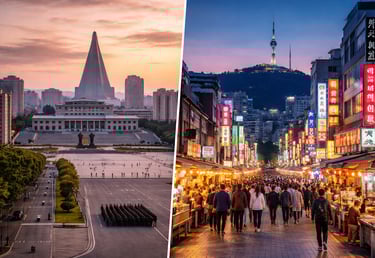
Neon lights illuminate skyscrapers. Massive digital billboards flash constantly. Subway systems move millions daily. Cafes are packed with students and entrepreneurs.
The pace is fast. The energy is entrepreneurial.
From high-speed internet everywhere to seamless digital payments, South Korea operates at global speed. Innovation is visible — not abstract.
Youth culture dominates areas like Gangnam and Hongdae. Music, fashion, gaming, and tech startups thrive side by side.
Convenience stores operate 24/7. Food delivery is hyper-efficient. Coffee chains compete on every block.
The contrast from Pyongyang is immediate and undeniable.
Freedom of Expression: The Sharpest Contrast
In South Korea, public debate is normal. Media outlets present varying viewpoints. Citizens actively discuss politics, policies, and social issues online.
You see influencers, commentators, journalists, and activists speaking openly.
In North Korea, messaging is unified and controlled. Public criticism is not visible.
As a traveler, this difference becomes the most profound realization.
Freedom is easy to overlook when you’ve always had it.
Seeing a society operate without visible public dissent forces you to rethink what freedom truly means.
Economic Development: A Dramatic Gap
South Korea has transformed into one of the most advanced economies globally.
Major corporations such as Samsung, Hyundai Motor Company, and LG Corporation dominate global markets.
Infrastructure reflects this growth — advanced hospitals, high-speed trains, world-class airports, and strong global trade ties.
North Korea, by contrast, operates under economic isolation and international sanctions. The consumer market is limited. Industrial output is restricted. Trade access is constrained.
In Seoul, you choose between dozens of brands and services.
In Pyongyang, options are carefully structured and far fewer.
The difference isn’t subtle — it’s systemic.
Culture and Entertainment: Collective vs Global
In North Korea, cultural performances emphasize unity and national pride. Large synchronized events highlight discipline and collective identity.
Entertainment reinforces ideology.
In South Korea, culture is exported worldwide.
K-pop concerts fill massive arenas. Film and television reach global streaming platforms. The country actively shapes global pop culture trends.
The entertainment industry in South Korea functions as both economic engine and international soft power.
Two countries. Two completely different cultural strategies.
The Korean Demilitarized Zone: A Line That Changed History
Standing near the Korean Demilitarized Zone is a surreal experience.
Just a narrow strip of land separates two political systems, two economic realities, and two futures.
The division traces back to the Korean War, which ended in an armistice, not a peace treaty.
Technically, the conflict was never formally concluded.
This border is more than physical — it is ideological.
The Human Element: Shared Roots, Different Paths
Despite everything, the people remain human in both places.
Parents care deeply for their children. Young adults form friendships. Elders sit quietly in parks.
The Korean language connects both societies. Historical traditions overlap. Cuisine shares similarities.
Yet opportunity and exposure differ dramatically.
In South Korea, young professionals talk about startups, investments, global travel, and remote work.
In North Korea, life paths appear more predetermined and structured.
It made me reflect on how deeply systems shape destiny.
What Impacted Me the Most
It wasn’t wealth.
It wasn’t poverty.
It wasn’t even technology.
It was narrative control.
In North Korea, the story of the nation is unified and consistent.
In South Korea, multiple narratives compete, evolve, and clash openly.
Information shapes reality. And both societies demonstrate how powerful that shaping can be.
Which One Is Better?
That question depends entirely on values.
If you prioritize:
Freedom of expression
Business opportunity
Open internet
Global integration
Rapid innovation
South Korea clearly provides more pathways.
If you prioritize:
Strict social order
Collective ideology
Reduced consumer pressure
Uniform national identity
North Korea presents a very different model.
But from a traveler’s perspective, the differences in opportunity and freedom are impossible to ignore.
Final Reflection: One Peninsula, Two Outcomes
Visiting both countries changed the way I think about governance and globalization.
Two nations share history, culture, and geography.
Yet today, they represent two entirely different systems of economic organization, political control, and social expression.
Walking through Pyongyang’s controlled calm and then Seoul’s electric skyline forces you to confront the real-world consequences of policy, leadership, and global engagement.
The Korean Peninsula is divided not just by a border, but by ideology, economic integration, and information access.
And once you witness both realities, you never look at the concept of “freedom” the same way again.
© 2026. All rights reserved.