
The Future of Travel: Why You May Never Need to Board a Plane Again
What if you could visit Paris, Tokyo, or the pyramids of Egypt without boarding a plane? Discover how virtual reality, AI, and new technologies could completely transform the future of travel.
3/12/20265 min read
A World Where Travel Doesn’t Require Movement
For centuries, travel meant physically moving from one place to another. People crossed oceans by ship, traveled long distances by train, and eventually flew across continents in airplanes. Traveling to another country was once considered a rare and expensive adventure.
But technology is beginning to challenge that traditional idea.
In the coming decades, experts believe that a new type of travel could emerge—one where people can explore cities, landmarks, and cultures without ever leaving their homes.
Advances in virtual reality, artificial intelligence, ultra-fast internet, and immersive digital environments are opening the door to a future where the entire world could be accessible from a living room.
While physical travel will never disappear completely, the way humans experience destinations could change dramatically.
The Rise of Virtual Travel Experiences
Virtual travel is already beginning to appear in many forms.
Museums offer digital tours, historical sites provide 360-degree experiences, and travel companies are experimenting with immersive previews of destinations.
These early experiences are just the beginning.
As technology improves, virtual travel could become far more advanced. Instead of simply watching a video of a location, users could step into fully interactive digital worlds that replicate real places.
Imagine walking through the streets of Paris, standing on a beach in Thailand, or exploring ancient ruins in Peru—all while sitting at home.
These environments could be designed to feel incredibly realistic, allowing people to explore locations almost as if they were physically there.
How Virtual Reality Could Transform Tourism
Virtual reality is expected to play a central role in the future of travel.
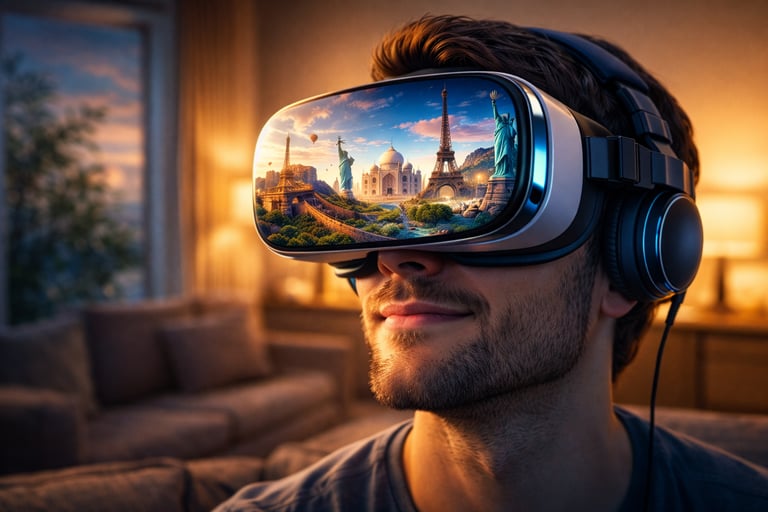
VR headsets allow users to enter immersive environments where they can look around in every direction and interact with objects and other users.
Unlike traditional screens, VR surrounds the viewer with a digital environment, creating a strong sense of presence.
In the future, tourism companies could create highly detailed digital versions of famous locations.
Users might be able to walk through:
The Great Wall of China
The streets of Rome
The pyramids of Egypt
The Eiffel Tower in Paris
The temples of Kyoto
These experiences could include realistic sounds, lighting, and even guided tours led by experts.
Instead of watching travel videos, people could experience destinations in a much more immersive way.
Artificial Intelligence as a Personal Tour Guide
Artificial intelligence will likely become an essential part of digital travel.
AI-powered guides could accompany visitors through virtual environments, providing detailed explanations about landmarks, history, and culture.
Instead of reading information panels or guidebooks, users could simply ask questions.
For example, someone exploring a digital version of Rome could ask:
“Who built this monument?”
“How old is this building?”
“What happened here historically?”
The AI guide could instantly provide answers and suggest other places to explore.
These intelligent systems could personalize each experience based on a user’s interests.
Someone interested in history might receive deeper historical context, while someone interested in architecture might receive detailed explanations about design and construction.
Experiencing Culture Without Traveling
Travel is not only about visiting landmarks. It is also about experiencing cultures, traditions, and daily life in different parts of the world.
Future digital travel platforms could allow people to participate in cultural experiences remotely.
Users might attend:
Festivals in India
Street markets in Thailand
Concerts in Europe
Traditional ceremonies in Africa
Art exhibitions in New York
Through immersive environments, people could observe these events, interact with others, and learn about traditions.
This could create a powerful way to connect people across cultures without requiring physical travel.
Education Through Digital Exploration
The future of travel could also transform education.
Students could explore historical locations through immersive environments instead of simply reading about them in textbooks.
Imagine students visiting ancient cities, walking through medieval castles, or exploring underwater coral reefs through virtual experiences.
Teachers could guide students through these environments while explaining historical events, scientific discoveries, or cultural developments.
This type of learning could make education far more engaging and interactive.
By turning history and geography into immersive experiences, digital travel could revolutionize the way people learn about the world.
Environmental Impact of Traditional Travel
One of the major concerns about modern tourism is its environmental impact.
Air travel is responsible for a significant amount of global carbon emissions. Large numbers of tourists visiting fragile ecosystems can also damage natural environments.
While travel will remain important, digital experiences could reduce the need for certain types of trips.
For example, people might explore destinations virtually before deciding whether to visit them physically.
Some experiences that require long flights might be enjoyed digitally instead.
Although virtual travel will not replace tourism entirely, it could help reduce environmental pressure on some destinations.
Making the World Accessible to Everyone
Another major advantage of digital travel is accessibility.
Physical travel is not always possible for everyone. Some people face financial limitations, health conditions, or mobility challenges that make long-distance travel difficult.
Digital tourism could make the world accessible to many more people.
Anyone with an internet connection could explore famous landmarks, learn about cultures, and experience destinations that might otherwise remain out of reach.
This could transform travel from an activity limited to tourists into something accessible to a global audience.
Social Travel in Virtual Worlds
Future travel experiences may also include social interactions.
Instead of exploring destinations alone, people could travel virtually with friends or meet new people from around the world.
Groups might explore cities together, attend digital events, or participate in guided tours.
Travel communities could form around shared interests such as history, architecture, food, or photography.
These interactions could create new forms of tourism that blend entertainment, education, and social connection.
The Technology That Will Make It Possible
Several technological developments will help enable the future of digital travel.
Virtual reality hardware continues to improve, becoming lighter, more comfortable, and more powerful.
Internet speeds are increasing with the expansion of fiber networks and advanced wireless technologies.
3D scanning and mapping technologies allow real-world locations to be captured in extremely detailed digital formats.
Artificial intelligence can generate realistic environments and manage complex interactions within virtual worlds.
Together, these technologies could create travel experiences that feel increasingly realistic.
Will Virtual Travel Replace Real Travel?
Despite the potential of digital tourism, physical travel is unlikely to disappear.
There are aspects of travel that cannot be fully replicated digitally, such as tasting local food, feeling the climate of a place, or experiencing the atmosphere of a bustling city.
However, digital travel could become an important complement to traditional tourism.
Some people might explore destinations virtually before planning a real trip.
Others may use digital travel to experience places they cannot visit physically.
In this way, virtual tourism could expand the overall travel ecosystem rather than replace it.
The Future Tourism Industry
The travel industry may evolve into a hybrid model that combines physical and digital experiences.
Tourism companies may offer virtual experiences alongside traditional packages.
Destinations could promote themselves through immersive digital previews.
Travelers might explore locations virtually, attend digital cultural events, or learn about destinations before visiting them.
This combination of physical and digital experiences could create new opportunities for the tourism industry.
A New Way to Experience the World
Human curiosity about the world has always driven exploration.
From ancient explorers crossing oceans to modern travelers flying across continents, the desire to discover new places is deeply rooted in human nature.
Technology may soon allow people to satisfy that curiosity in new ways.
Instead of being limited by distance, cost, or time, people may be able to explore the world instantly through immersive digital environments.
While physical travel will always remain special, digital travel could open the doors of the world to billions of people.
Final Thoughts
The future of travel is likely to look very different from today.
Virtual reality, artificial intelligence, and advanced connectivity are creating new possibilities for exploring the world.
One day, people may be able to visit famous landmarks, attend cultural events, and experience global destinations without ever boarding a plane.
This transformation could make travel more accessible, more sustainable, and more immersive than ever before.
The world may soon be closer than we ever imagined.
© 2026. All rights reserved.