
Train vs Plane: Which is the Better Travel Mode in 2026 | Travel Explorer Exclusive
Travel Explorer compares train and plane travel in 2026 — exploring cost, comfort, speed, sustainability, and convenience to reveal which transport option wins for modern travelers.
11/9/20254 min read
Train vs Plane: Which is the Better Travel Mode in 2026
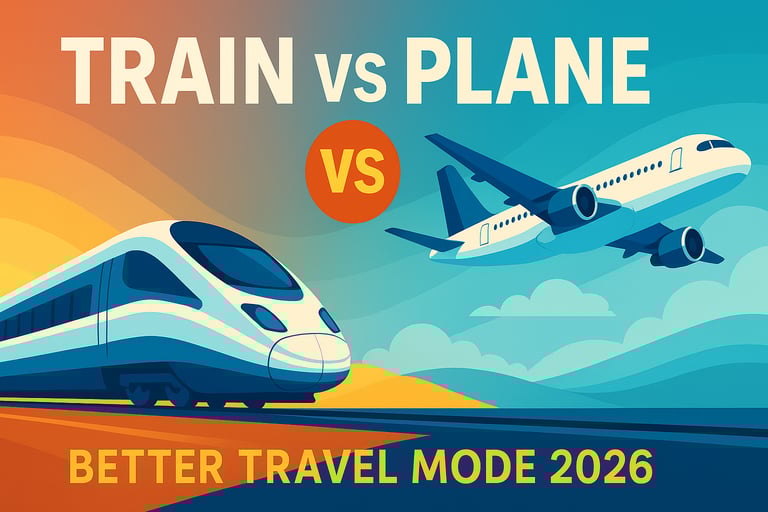
In 2026, travelers are more conscious than ever about how they move across the world. With advanced high-speed trains and more efficient aircraft, the big question remains: which is better — trains or planes?
As both industries evolve with technology, travelers now prioritize comfort, time, sustainability, and cost-effectiveness. The decision depends on what matters most to each traveler, but understanding the pros and cons of both helps you make the smarter choice.
The Modern Travel Revolution
The 2020s have changed how the world travels. Airlines have become faster and smarter, adopting greener technologies, while train systems have expanded into high-speed, comfortable, and sustainable networks.
In 2026, both options have unique advantages. Electric and hydrogen trains now dominate most routes across Europe and Asia. Meanwhile, airlines are introducing sustainable fuel options and even AI-driven flight scheduling.
What was once a simple choice between cost and convenience has become a deeper decision involving the planet, time, and experience.
Speed Comparison: Planes Still Win on Distance
Planes continue to dominate long-distance travel. A modern jet can cover thousands of kilometers in just a few hours, while even the fastest trains are designed for shorter routes.
But real-world travel isn’t just about airspeed. A flight might take only one hour, but check-in, boarding, and security checks can add two more. Trains, on the other hand, usually let you board 10–15 minutes before departure.
For shorter journeys — especially under 600 kilometers — trains often match or even outperform planes when total travel time is considered.
Travel Explorer Insight: Air travel is unbeatable for crossing continents, but for short or medium routes, high-speed trains are faster door-to-door.
Cost Factor: Trains Take the Lead
In 2026, airfares have risen due to higher fuel costs and carbon taxes. Trains, supported by government incentives for green travel, now offer cheaper and more stable ticket prices.
For instance, a short domestic flight that costs around $100 might be replaced by a high-speed train ticket priced between $50 and $70 — and without baggage or seat fees.
Trains also offer simple refunds and flexible rescheduling. Airlines still charge extra for baggage, meals, and even seat selection, making total costs higher than they appear.
Travel Explorer Verdict: For affordability, flexibility, and transparency, trains are the clear winner.
Comfort and Experience: Trains Offer More Freedom
Comfort plays a huge role in travel satisfaction. In 2026, most long-distance trains have upgraded interiors with more legroom, smoother seats, Wi-Fi, and food service comparable to airlines.
Unlike planes, trains allow passengers to move freely between coaches, enjoy scenic routes, and carry unlimited luggage. There’s no cramped cabin, no seatbelt signs, and no turbulence — just smooth, scenic travel.
Planes still hold an advantage for luxury travelers with first-class and business seats, but for everyday journeys, trains provide unmatched comfort and ease.
Environmental Impact: Trains Win for Sustainability
By 2026, sustainability is the heart of the travel industry. Electric and hydrogen trains have reduced carbon emissions drastically, while planes still emit far more per passenger.
An average train emits roughly one-fourth the CO₂ of a similar flight. Many modern train lines are now powered entirely by renewable energy sources.
Airlines are working hard to reduce emissions with biofuels and hybrid jets, but it will take years before aviation becomes truly green.
Travel Explorer Insight: If you care about the environment, taking the train is the most responsible choice in 2026.
Accessibility and Convenience
Trains have a major advantage when it comes to accessibility. Most railway stations are located in city centers, while airports are far away, requiring extra transfers.
This makes trains perfect for regional travel. You can go from city to city without worrying about baggage screening or strict check-in times.
Planes are ideal for international and intercontinental travel. But for regional routes across Europe, India, China, and Japan, high-speed rail is the most convenient option.
Travel Explorer Tip: If your trip is within 1000 kilometers, trains are usually faster and cheaper. Beyond that, flying becomes more practical.
Technology and Modern Features
Both trains and planes in 2026 are more high-tech than ever before.
Airlines have introduced digital boarding, biometric check-ins, and real-time AI route optimization that reduces delays. Some airlines even use electric-powered aircraft for short-haul flights.
Trains, on the other hand, have become digital ecosystems. Smart ticketing, AI delay prediction, on-demand entertainment, and self-cleaning systems are now standard. Maglev (magnetic levitation) lines in China and Japan have hit record speeds of over 600 km/h, making rail almost as fast as air.
Both travel modes are evolving, but in different directions — planes for speed, trains for experience.
Safety and Reliability
Both trains and planes are statistically among the safest travel modes, but reliability differs.
Flights face more delays due to weather, air traffic, and technical checks. In 2026, about one in five flights still faces a delay of over 30 minutes. Trains, especially high-speed ones, have improved reliability rates, with fewer cancellations and weather disruptions.
Trains are also less stressful — no turbulence, no sudden altitude changes, and minimal waiting times.
Travel Explorer Verdict: For peace of mind and consistency, trains take the edge.
Overall Experience: What Travelers Value More
The experience of traveling by train and plane are completely different.
Trains allow travelers to see landscapes, interact with locals, and feel the journey itself. Flying is about reaching the destination fast and efficiently.
The choice often depends on the traveler’s mindset. Adventurers, eco-conscious travelers, and digital nomads lean toward trains. Business travelers and time-sensitive passengers still prefer planes.
Travel Explorer Insight: The train wins for emotion and experience; the plane wins for efficiency.
Hybrid Travel — The New Trend of 2026
A growing number of travelers now combine both trains and planes for optimal balance. For example, taking a high-speed train to a nearby international airport, then flying long-distance.
This hybrid model reduces both costs and emissions. Airlines and rail networks now collaborate on combined tickets that automatically sync flight and train schedules.
This seamless integration means travelers get the best of both worlds — speed and sustainability.
Travel Explorer Final Verdict
Trains and planes both serve vital roles in the modern travel ecosystem. The best choice depends on your distance, budget, and purpose.
Choose the plane if you’re traveling internationally, value speed, or need loyalty rewards. Choose the train if you care about sustainability, comfort, and affordability.
In 2026, trains have become the preferred mode for short to medium distances, while planes remain essential for intercontinental journeys.
The smartest travelers don’t pick sides — they use both strategically.
Travel Explorer Message:
Trains connect the journey. Planes connect the world. The future of travel is balance — comfort on the rails, freedom in the skies.
© 2026. All rights reserved.