
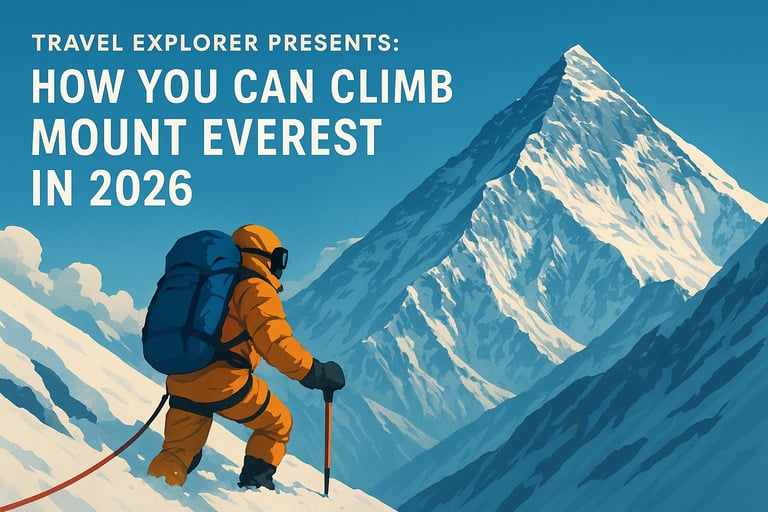
Travel Explorer Presents: How You Can Climb Mount Everest in 2026
A detailed 2026 Mount Everest climbing guide by Travel Explorer — covering preparation, training, costs, permits, risks, Sherpa support, weather windows, and the complete journey from dream to summit.
ASIA
11/15/20257 min read
Travel Explorer Presents: How You Can Climb Mount Everest in 2026
Climbing Mount Everest is one of the most extraordinary goals a person can set for themselves. Every year, only a few determined climbers reach the top of the world, a place where the sky feels closer than the Earth below. Many people look at Everest and think it is a dream reserved for highly trained athletes, professional mountaineers, or the extremely rich. But reality is different. With dedication, proper planning, the right expedition support, and one year of disciplined training, climbing Mount Everest in 2026 can become a real possibility for an ordinary person as well. Travel Explorer brings you one of the most complete and easy-to-understand Everest guides, breaking down each stage of your journey with absolute clarity.
Everest in 2026 is expected to be one of the busiest yet safest seasons due to better weather prediction technology, improved route fixing systems, new oxygen standards, and more organized expedition companies. Many climbers have spent years preparing after the travel slowdown of the early 2020s, and now they are ready to return. If you are dreaming of joining them, this blog will help you understand every detail — from your first training session to your moment on the summit. Travel Explorer takes you step-by-step across the emotional, physical, technical, financial, and psychological reality of climbing the highest mountain in the world.
Turning a Thought into a Real Everest Mission
The first step toward Everest is not physical. It’s mental. Most dreams collapse because people convince themselves they’re not capable. The biggest barrier is self-belief. Before you buy gear or sign up with an expedition company, you need to be sure that you truly want this. A mountain like Everest demands your commitment. It is not a place you visit casually. It’s a place where you must willingly accept discomfort, altitude, and risk.
If you are planning Everest 2026, your real journey begins today. The moment you decide that you are going to climb this mountain, your lifestyle begins to shift. Your training becomes focused. Your day-to-day habits start supporting your dream. You begin choosing discipline over excuses. Mental strength is the foundation of Everest. Many climbers with excellent physical fitness have turned back because mentally they fell apart. The cold, isolation, fear, and altitude challenge your mind more than your body.
To prepare mentally, visualize the pain, the slow climbs, the sleepless nights, and the thin air. The more mentally prepared you are for hardship, the less shocked you’ll feel on the mountain. Everest rewards calmness, patience, and resilience. It punishes ego, rush, and panic. If your mind is strong, the mountain becomes much less overwhelming.
Choosing Your Path: Nepal South Side or Tibet North Side
Everest has two primary routes, each with its own advantages. The South Side in Nepal is the most popular because it’s more accessible and has a long history of commercial expeditions. It includes the famous Khumbu Icefall, a shifting maze of ice towers, crevasses, and ladders. Though dangerous, the Icefall is well managed by the Icefall Doctors who maintain the route daily during climbing season. Most first-time Everest climbers choose this side because of better rescue support, more experienced Sherpa teams, and more established base camp facilities.
The North Side in Tibet is less crowded and has no icefall, but the winds can be harsher and the route more exposed. The final sections are steeper and more challenging technically. Climbers who choose the north route often have more altitude experience. Whichever you choose, remember that both require endurance, strength, and mental toughness. Travel Explorer strongly encourages first-timers to take the Nepal route because rescue, helicopter access, and medical support are significantly more reliable.
Understanding the Costs of Everest 2026
Money is often the biggest barrier. For the 2026 season, climbing Everest from Nepal is expected to cost between ₹25 lakh and ₹60 lakh depending on the expedition operator. Cheaper teams usually compromise on oxygen quality, Sherpa ratio, tent durability, and food. On Everest, cutting costs can be dangerous. High-quality expeditions provide thicker down suits, better oxygen regulators, experienced high-altitude Sherpas, and safer logistics.
Your 2026 budget should include:
– International flights
– Nepal visa and travel insurance
– Expedition fees
– Gear such as down suits, double boots, gloves, crampons, helmets, and sleeping bags
– Additional oxygen bottles
– Base camp Wi-Fi, hot showers, and food
– Tips for Sherpas and support teams
– Pre-Everest training climbs and gear rentals
One of the surprising expenses is high-altitude gear. A good down suit can cost between 70,000 to 1,00,000 rupees, and high-altitude double boots cost almost the same. Gloves, mittens, and socks cost more than most people expect. It’s essential to invest in quality gear because the mountain gives no second chances. Cold, wind, or faulty equipment can be fatal.
Your Preparation Timeline for Everest 2026
If you want to climb Everest in 2026, you need at least 12–18 months of preparation. Your training split should include endurance building, strength training, stair climbing, long hikes, altitude adaptation, and learning technical skills. Travel Explorer recommends a structured timeline:
In the first months, focus on building cardiovascular strength using running and cycling. Add weekly long hikes with increasing weight in your backpack. Your legs must become machines that can move for hours without collapsing. Your lungs need to improve oxygen efficiency. As the months pass, begin strength training to build a solid back and core.
In late 2024 or early 2025, sign up for your first high-altitude trekking or climbing experience. Peaks like Island Peak, Lobuche East, and Mera Peak in Nepal or Stok Kangri and Kang Yatse in India help you experience altitude firsthand. These climbs teach you how to walk with crampons, use ropes, and manage equipment with gloves. Everest is not the place to learn new skills. You must already be comfortable with mountaineering techniques before the expedition begins.
Physical Requirements for Everest
Everest doesn’t demand the body of a bodybuilder. It demands the body of a person who can climb, walk, and endure cold for hours. Focus on endurance, not aesthetics. You need strong quads, calves, and hamstrings, along with a stable core and flexible lower back. Running improves your cardiovascular base. Stair climbing simulates actual mountaineering. Long hikes help you build slow, sustainable strength. Travel Explorer encourages mixing all three.
The high altitude will drain your muscles quickly. Even simple tasks like walking or tying your boots feel exhausting above 7000 meters. That’s why you must train your body to function with as little energy waste as possible. Functional strength matters more than gym strength. It’s better to walk 10 km uphill than to deadlift 140 kg in the gym.
Technical Skills You Must Have
Everest requires basic but solid mountaineering skills. You must know how to use crampons correctly without tripping. You must feel confident walking on ice and snow. You must understand how to clip in and out of fixed ropes efficiently. You must know how to descend steep slopes with control.
One of the greatest challenges is moving confidently with thick gloves in freezing temperatures. Small tasks become difficult when your fingers are numb. Practicing rope techniques, knot handling, and ice axe use in cold conditions is essential. Many climbers fail because they panic while switching carabiners or stepping on ladders across deep crevasses. Skills that feel simple at sea level can feel terrifying high up, so repetition and familiarity are key.
Life at Base Camp: The Beginning of the Real Journey
Everest Base Camp becomes your home for nearly two months. It feels like a small moving city filled with hundreds of climbers, sherpas, cooks, tents, equipment, and massive ice towers everywhere around you. Base camp life is a mix of comfort and discomfort. The dining tents serve hot food, there are sleeping tents, medical tents, and communication areas, but the cold is constant. Nights often drop below −15°C, and the winds can shake your tent violently.
This is where patience becomes your biggest weapon. Some days are spent waiting for avalanche risk to decrease. Some days you practice techniques. Some days you sit under the sun and talk to other climbers. Travel Explorer highlights that base camp is also an emotional test. You hear avalanches in the distance. You see helicopters rescuing exhausted climbers. You understand the seriousness of the mountain. But you also see courage, discipline, and humanity at its best.
Acclimatization Rotations: Training the Body for Thin Air
Everest requires your body to slowly adapt to decreasing oxygen levels. This is done through rotations — climbing up to higher camps and returning to base camp to rest. These rotations usually involve climbing from Base Camp to Camp 1, then to Camp 2, and sometimes Camp 3 before coming back down.
Rotations teach your lungs how to handle thin air. You feel breathless at first, but eventually your body starts producing more red blood cells. You learn how to move slowly, how to breathe correctly, and how to conserve energy. Rotations also introduce you to the mountain. You cross the Khumbu Icefall, climb the Western Cwm, and touch the Lhotse Face. By the time you’re ready for the summit push, these places feel familiar rather than intimidating.
Summit Push: The Hardest Night of Your Life
Summit push begins only when the weather window is perfect. Winds must drop, and temperatures must stabilize. The climb from Camp 4 to the summit usually begins at night. The world around you will be silent, black, and cold. You hear only your breathing and the crunching snow under your crampons. Your Sherpa adjusts your oxygen flow, checks your gear, and keeps you focused.
The route takes you through the Balcony, the South Summit, the Hillary Step area, and finally the summit ridge. The air is thin and every step feels slow. Your legs burn. Your hands freeze. Your body begs to stop. But your mind must stay strong. Eventually, the darkness fades and you see the sunrise over the Himalayas. When you reach the summit, you stand at 8,848 meters — the highest point on Earth. The feeling is beyond words. Some climbers cry, some pray, some simply stare at the world below. But you must remember that the real challenge is descending safely. Most Everest accidents happen after the summit because climbers relax too early.
The Power of Sherpa Support
Sherpas are the true heroes of Everest. They fix ropes, carry loads, set camps, repair equipment, cook food, and guide climbers. Their experience at altitude is unmatched. A good Sherpa can save your life, keep you motivated, and prevent critical mistakes. Respecting them is essential. Travel Explorer emphasizes choosing an expedition company that treats Sherpas fairly and provides proper wages, insurance, and safety equipment.
The Real Dangers of Everest
Everest is beautiful but dangerous. Avalanches, crevasses, frostbite, altitude sickness, and sudden storms can threaten your life. Your best protection is preparation and humility. Overconfidence is deadly on Everest. The mountain demands respect. If your body signals danger, turning back is the smartest decision. Everest will always be there. Your life comes first.

© 2026. All rights reserved.