
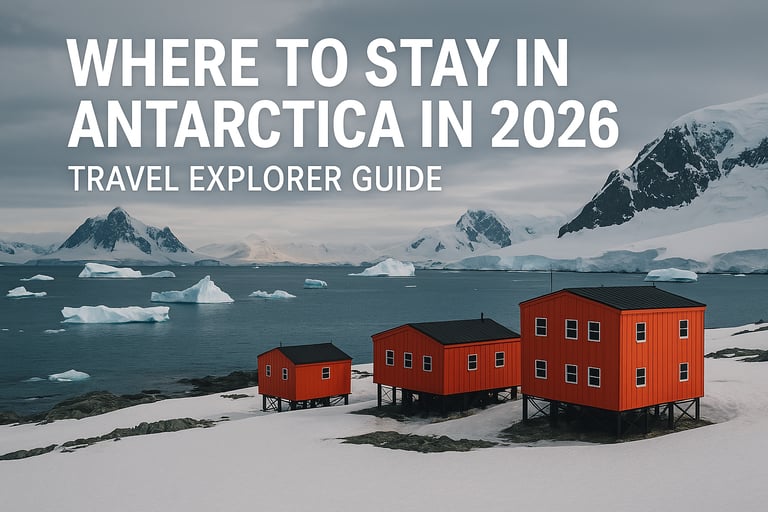
Where to Stay in Antarctica in 2026 | Travel Explorer Guide
This Travel Explorer guide explains where and how travelers can stay in Antarctica in 2026, covering research stations, expedition ships, temporary field camps, luxury polar cruises, safety rules, legal restrictions, costs, and what accommodation in the world’s most extreme continent is really like.
ANTARCTICA
12/15/20254 min read
Introduction: Can You Really Stay in Antarctica?
Antarctica has always been the ultimate frontier for travelers. It is the coldest, driest, windiest, and most remote continent on Earth. Unlike other destinations, Antarctica has no cities, no permanent residents, no hotels in the traditional sense, and no tourism infrastructure like airports, roads, or resorts.
Yet, in 2026, people are visiting Antarctica in increasing numbers—scientists, explorers, adventure tourists, photographers, filmmakers, and even luxury travelers.
The question is not whether you can stay in Antarctica, but where, how, and under what strict conditions.
This Travel Explorer guide breaks down every realistic accommodation option in Antarctica in 2026, from scientific research stations to expedition ships and temporary camps, along with costs, safety rules, and legal boundaries.
Understanding Antarctica’s Unique Status
Before discussing accommodation, it is essential to understand one key fact:
Antarctica does not belong to any country.
The continent is governed under the Antarctic Treaty System, which:
Prohibits permanent civilian settlement
Restricts commercial construction
Prioritizes scientific research and environmental protection
Because of this, traditional hotels are illegal, and all stays are temporary, regulated, and purpose-driven.
Every overnight stay in Antarctica must comply with strict international environmental and safety guidelines.
Option 1: Staying on Expedition Cruise Ships
The Most Common Way to “Stay” in Antarctica
For most visitors in 2026, staying in Antarctica does not mean sleeping on land—it means sleeping on an expedition ship anchored offshore.
How It Works
You travel by ship from South America
The ship crosses the Drake Passage
You explore Antarctica during the day
You sleep on the ship at night
Accommodation Type
Private cabins
Shared cabins
Luxury suites (on premium vessels)
Who This Is For
First-time Antarctica visitors
Photographers
Nature and wildlife enthusiasts
Travelers prioritizing safety and comfort
Advantages
Warm, stable accommodation
Medical facilities onboard
Professional guides and scientists
Minimal environmental impact
Limitations
You are not sleeping on Antarctic land
Time onshore is limited
Weather dictates daily plans
In 2026, expedition ships remain the safest and most accessible accommodation option for Antarctica.
Option 2: Antarctic Research Stations (Limited Access)
Not Hotels — Working Scientific Bases
Antarctica is home to dozens of international research stations, operated by various countries. These stations are primarily for scientists, engineers, and support staff.
Can Tourists Stay Here?
Generally, no.
However, in rare cases:
Journalists
Filmmakers
Government observers
Specialized researchers
may receive permission to stay temporarily.
Living Conditions
Dormitory-style rooms
Shared bathrooms
Cafeteria food
Extremely strict routines
Reality Check
These stations are:
Functional, not comfortable
Isolated for months
Emotionally demanding
This is not tourism accommodation. It is survival-focused living.
Option 3: Temporary Polar Camps (On the Ice)
The Closest Thing to Staying “In” Antarctica
For high-end adventure travelers in 2026, temporary polar camps are the closest experience to living on Antarctic land.
What Are Polar Camps?
Seasonal tented camps
Built on ice or snow
Removed completely after the season
Accommodation Style
Heated expedition tents
Insulated sleeping systems
Shared dining tents
Who This Is For
Extreme adventurers
Mountaineers
South Pole explorers
Ultra-high-net-worth travelers
Advantages
True Antarctic immersion
On-land sleeping experience
Minimal crowds
Risks
Extreme cold
Isolation
Weather delays
Physical and mental stress
In 2026, these camps are heavily regulated and extremely expensive, but they offer the most authentic Antarctic stay.
Option 4: Luxury Antarctic Expeditions
Yes, Luxury Exists — Even Here
In recent years, Antarctica has seen the rise of ultra-luxury expedition experiences.
What Luxury Means in Antarctica
Heated suites
Private balconies
Gourmet dining
Onboard spas and wellness areas
Helicopter excursions
Where You Stay
High-end ice-class ships
Hybrid sea-air expeditions
Reality
Luxury does not remove:
Harsh weather
Isolation
Environmental rules
But it does significantly improve comfort.
Option 5: Fly-In, Fly-Out Antarctic Camps
The Fastest Way to Stay on the Ice
In 2026, some travelers bypass ships entirely by flying directly to Antarctica.
How It Works
Fly from South America to Antarctica
Land on ice runways
Stay at temporary camps
Fly back after a short stay
Accommodation
High-grade expedition tents
Heated sleeping areas
Medical support onsite
Who Chooses This
Executives with limited time
South Pole goal-seekers
Scientific collaborators
This is one of the most expensive travel options on Earth.
Why You Cannot Stay Freely in Antarctica
Environmental Protection
Antarctica is one of the last untouched ecosystems.
No permanent buildings
No waste dumping
No wildlife disturbance
Safety Concerns
Temperatures can drop below −50°C
Medical evacuation can take days
Weather can change instantly
Legal Restrictions
Independent travel is not allowed
Permits are mandatory
Insurance requirements are strict
In 2026, Antarctica remains a place where freedom is secondary to preservation.
Cost Breakdown: What Staying in Antarctica Really Costs
Approximate Costs (2026)
Expedition ship stay: Very high
Luxury expedition: Extremely high
Polar camps: Ultra-expensive
Research station access: Restricted, non-commercial
Antarctica is not a budget destination. Cost reflects:
Logistics
Safety
Environmental compliance
What Daily Life Feels Like in Antarctica
Silence
No traffic. No cities. Just wind and ice.
Light Extremes
Endless daylight in summer
Constant darkness in winter
Mental Impact
Time feels slower
Isolation is intense
Nature dominates perception
Antarctica changes people psychologically.
Who Should Not Stay in Antarctica
Antarctica is not suitable for:
Casual tourists
People with untreated medical conditions
Those uncomfortable with isolation
Travelers seeking nightlife or convenience
This is not a vacation—it is an experience.
Best Time to Stay in Antarctica (2026)
Antarctic Summer
November to March
Milder temperatures
Wildlife activity
Outside this window, staying is nearly impossible.
What You Must Prepare Before Staying
Physical Preparation
Cold tolerance
Fitness
Mental resilience
Documentation
Permits
Insurance
Emergency evacuation plans
Gear
Specialized clothing
Insulation systems
Communication equipment
Travel Explorer Perspective
From a Travel Explorer standpoint, Antarctica is not about comfort or convenience. It is about respecting a continent that does not belong to humanity.
Where you stay in Antarctica is dictated by:
Safety
Science
Sustainability
Not personal preference.
Is Antarctica Worth Staying In?
For the right traveler, yes.
Antarctica offers:
Perspective
Humility
A sense of Earth’s fragility
It is one of the few places where humans are visitors—not masters.
Conclusion
In 2026, staying in Antarctica is possible, but only under strict rules and controlled conditions. Whether aboard an expedition ship, inside a temporary polar camp, or near a research station, every overnight stay is shaped by environmental responsibility and survival logistics.
Antarctica does not adapt to humans—humans must adapt to Antarctica.
For those seeking the ultimate frontier experience and willing to accept discomfort, discipline, and awe, Antarctica remains unmatched.
For more deep, honest travel insights into the world’s most extreme destinations, Travel Explorer continues to guide curious minds beyond the map.
© 2026. All rights reserved.