
Which Language Is Spoken in Antarctica? The Surprising Truth Most Travelers Don’t Know
Which language is spoken in Antarctica in 2026? Discover the surprising truth about communication on the world’s coldest continent, explained clearly by Travel Explorer.
ANTARCTICA
1/24/20264 min read
Introduction: A Continent Without a Native Language
Antarctica is one of the most mysterious places on Earth.
No cities. No permanent residents. No indigenous population. No government.
So a very natural question arises:
Which language is spoken in Antarctica?
The answer surprises most people—especially travelers, students, and geography enthusiasts. Unlike every other continent, Antarctica has no official language, no native tongue, and no single dominant way of speaking.
According to Travel Explorer, Antarctica is the only continent where language exists purely as a tool, not as an identity.
This article explains:
Why Antarctica has no language of its own
What languages are actually spoken there
How scientists and travelers communicate
What this means in 2026 for visitors and researchers
Why Antarctica Has No Native Language
Language develops when:
Humans settle permanently
Communities form over generations
Culture, tradition, and identity evolve
Antarctica has none of these conditions.
Key facts:
No indigenous population
No permanent civilian residents
No families or generational settlements
People come to Antarctica temporarily and leave.
As a result:
There is no “Antarctican language.”
This makes Antarctica unique in human history.
Who Actually Lives in Antarctica?
Before discussing language, it is important to understand who is present on the continent.
People in Antarctica include:
Scientists
Researchers
Engineers
Support staff
Military logistics crews
Limited adventure tourists
Most stay:
A few months
One research season
Occasionally one full year
Very few stay longer.
Since population constantly changes, language cannot stabilize or evolve naturally.
Is There an Official Language in Antarctica?
No.
Antarctica has:
No government
No constitution
No national identity
No official language
The continent is governed by international cooperation under the Antarctic Treaty System, which focuses on peace and science—not culture or language enforcement.
This means:
Every country brings its own language
No language has legal priority
Communication depends on practicality
So Which Languages Are Actually Spoken in Antarctica?
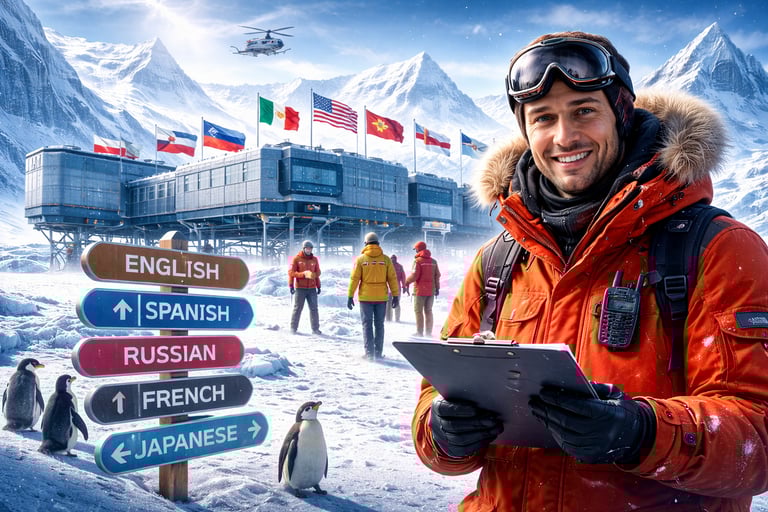
While there is no official language, many languages are spoken, depending on who is present at a particular research station.
English: The Most Common Working Language
English is the most widely used language in Antarctica, especially in:
International research stations
Emergency coordination
Aviation and logistics
Scientific collaboration
Why English dominates:
Most international science uses English
Mixed-nationality teams need a common medium
Safety protocols rely on shared language
Travel Explorer notes that English functions as the de facto working language, not by law, but by necessity.
Russian: One of the Oldest Languages in Antarctica
Russian has a long presence in Antarctica due to:
Historic Soviet research programs
Large Russian-operated stations
Long-term scientific investment
At Russian bases:
Russian is the primary internal language
English is often used externally
Some stations operate almost entirely in Russian when interaction with others is limited.
Spanish: Widely Spoken in Southern Stations
Spanish is commonly spoken due to:
Argentina
Chile
Uruguay
Spain
South American countries maintain strong Antarctic programs because of geographic proximity.
In many coastal stations:
Spanish is the dominant daily language
English is secondary for coordination
Other Languages Spoken in Antarctica
Depending on the station, you may hear:
French
German
Italian
Chinese (Mandarin)
Japanese
Korean
Norwegian
Each research base reflects the home country of its operators.
This means Antarctica is linguistically diverse—but fragmented.
How Do People Communicate Across Different Languages?
Since Antarctica is a high-risk environment, communication clarity is critical.
Common strategies include:
English as shared working language
Bilingual or multilingual staff
Pre-arrival language training
Standardized scientific terminology
Visual symbols and protocols
In emergencies:
English is almost always used.
This is not cultural preference—it is about survival.
What Language Do Scientists Use for Research?
Scientific work in Antarctica is:
Published internationally
Reviewed globally
Shared across borders
Therefore:
English dominates scientific writing
Data labels and logs are often bilingual
Internal notes may be in native language
Travel Explorer highlights that Antarctica’s science culture is one of the purest examples of global cooperation, with language used strictly as a functional tool.
Do Tourists Go to Antarctica? If Yes, What Language Is Used?
Yes, limited tourism exists.
Tourists typically arrive via:
Expedition cruises
Research-supported travel programs
Tourism language facts:
English is the primary language
Guides are multilingual
Safety briefings are usually in English
Translators are provided for major groups
Tourists do not need to know multiple languages to visit Antarctica.
Is Sign Language Used in Antarctica?
There is no formal record of:
A permanent deaf community
Institutional sign language use
However:
International sign systems may be used informally
Visual hand signals are common in harsh conditions
In extreme cold, verbal communication can be difficult, so gestures often supplement speech.
Why Antarctica Will Never Have Its Own Language
Language evolves through:
Time
Repetition
Community identity
Antarctica lacks all three.
Additionally:
Human presence is temporary
No children grow up there
No cultural continuity exists
Even in 2026 and beyond:
Antarctica will remain a continent of borrowed languages.
What Language Should You Learn If You Want to Work in Antarctica?
According to Travel Explorer guidance:
Essential Language
English
Helpful Additional Languages
Russian (for certain stations)
Spanish (South American bases)
French (select European programs)
But English alone is usually sufficient for:
Scientific roles
Support roles
Logistics and safety
Language and Survival in Antarctica
In Antarctica, language is not about:
Expression
Identity
Culture
It is about:
Safety
Precision
Coordination
Miscommunication can lead to:
Equipment failure
Medical emergencies
Fatal exposure risks
That is why:
Simple, clear, standardized language matters more than fluency.
How Language Reflects Antarctica’s Unique Nature
Antarctica teaches a powerful lesson:
No nation owns it
No culture dominates it
No language defines it
People coexist not through shared identity, but through shared responsibility.
This makes Antarctica:
The most neutral continent
The least political
The most cooperative
Language becomes a tool—not a boundary.
Common Myths About Language in Antarctica
Myth 1: Everyone Speaks English
False. English is common, but many stations use native languages internally.
Myth 2: Antarctica Has Its Own Language
Completely false. No native language exists.
Myth 3: You Must Know Multiple Languages to Visit
False. English is enough for tourism and most roles.
What Will Change in 2026 and Beyond?
By 2026:
More international missions exist
More countries participate
More languages are present
But one thing will remain unchanged:
Antarctica will never have a single language.
Technology may help:
Translation tools
AI-assisted communication
Yet human cooperation will still rely on simple shared language frameworks, mostly English.
Final Answer: Which Language Is Spoken in Antarctica?
There is no single language spoken in Antarctica.
Instead:
English is the most common working language
Many national languages coexist
Communication depends on purpose, not identity
Antarctica remains the only continent where language belongs to function, not people.
© 2026. All rights reserved.