
Why Are So Many “Massage” and Sex Service Cards Found on the Streets of Dubai? The Hidden Reality Behind the Headlines
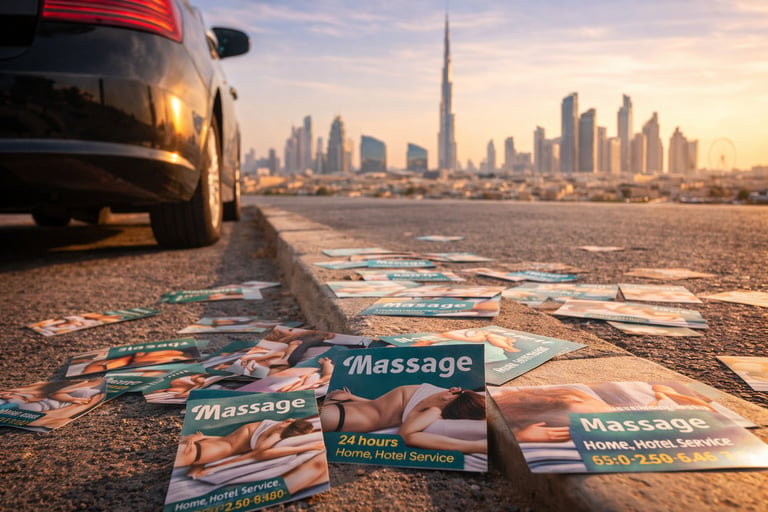
Visitors to Dubai are often shocked to see escort and massage cards scattered across certain streets. If prostitution is illegal, why do these cards appear? Here’s a detailed look at the legal, social, and economic reality behind this phenomenon.
ASIA
2/20/20264 min read
The Unexpected Sight in a Luxury City
When people think about Dubai, they imagine futuristic skylines, luxury shopping malls, and iconic landmarks like Burj Khalifa.
Dubai markets itself as one of the safest and most modern cities in the world. It has strict laws, heavy surveillance, and strong law enforcement. So when tourists walk through certain neighborhoods and see glossy “massage service” cards scattered on streets or placed on car windshields, it feels contradictory.
This raises important questions:
If prostitution is illegal, why are these cards visible?
Who is printing and distributing them?
Why hasn’t the government eliminated them completely?
To understand this, we need to examine legal frameworks, economic drivers, enforcement limitations, and underground networks.
Understanding the Legal Framework in the UAE
Is Prostitution Legal in Dubai?
No. Prostitution is illegal under UAE federal law.
The United Arab Emirates operates under a combination of civil law and Sharia-influenced legal principles. Activities considered illegal include:
Soliciting prostitution
Running brothels
Human trafficking
Public indecency
Distribution of explicit materials
Penalties can include fines, imprisonment, deportation, and blacklisting.
Dubai, as one of the seven emirates of the UAE, enforces these laws strictly — especially when activities are public or visible.
So officially, prostitution is banned.
What Are These “Massage Cards” Actually Advertising?
The Use of Coded Language
Most cards do not openly say “sex service.” Instead, they use coded terms like:
“Relax massage”
“VIP service”
“Home service”
“24/7 hotel service”
These are euphemisms. The advertisement presents itself as a legitimate massage service, but in many cases, the implied offering is sexual.
This ambiguity creates a legal gray area.
If authorities can prove prostitution or solicitation, arrests occur. But if the advertisement claims to be a legal massage service, enforcement becomes more complex.
Why Do These Cards Appear So Frequently?
1. High Demand in a Transient Population
Dubai has a unique demographic structure.
Over 80% of the population consists of expatriates.
A large portion of residents are single working men.
Many people live away from families for years.
In global cities with large transient populations, underground vice markets often emerge. This is not unique to Dubai — similar patterns exist in cities like Bangkok, London, or New York.
Where demand exists, supply tends to follow.
2. Tourism and Nightlife Zones
Dubai attracts millions of tourists annually. Areas near nightlife districts and certain residential buildings with short-term rentals often see higher concentrations of these cards.
Tourism-driven demand can create informal underground networks seeking quick cash through discreet advertising.
3. Low-Cost, Easy Distribution Model
Printing these cards is inexpensive.
Distribution is typically done late at night. Individuals walk through streets, parking areas, and apartment entrances scattering hundreds at once.
Even if authorities clean them up the next morning, new ones may appear the following night.
This “volume strategy” makes enforcement reactive rather than preventive.
Why Doesn’t the Government Eliminate Them Completely?
This is the key question.
1. Enforcement Is Ongoing — But It’s a Cat-and-Mouse Game
Dubai Police frequently conduct crackdowns targeting:
Illegal massage parlors
Human trafficking rings
Distribution networks
Individuals soliciting clients
However, underground markets are adaptive.
When one network is shut down, another appears. Phone numbers change regularly. SIM cards are frequently replaced.
It becomes a repetitive enforcement cycle.
2. Distinguishing Legal Massage from Illegal Activity
Dubai has thousands of legitimate licensed spas and massage centers.
Authorities must distinguish between:
Legal businesses
Illegal fronts operating under the guise of massage services
This requires surveillance, undercover operations, and evidence collection.
That takes time and resources.
3. Reputation Management Strategy
Dubai prioritizes public image and stability. Large-scale public scandals are generally avoided. Enforcement actions happen, but they are not always highly publicized unless major trafficking cases are involved.
The city maintains a zero-tolerance legal framework while managing realities on the ground through continuous policing rather than headline-driven campaigns.
The Role of Human Trafficking Concerns
One of the most serious issues connected to underground sex markets globally is trafficking.
The UAE has implemented anti-trafficking laws and international cooperation frameworks. Authorities prosecute organized exploitation networks when discovered.
It is important to separate:
Independent illegal solicitation
Organized trafficking rings
The latter carries severe penalties and receives focused law enforcement attention.
Why These Cards Are Mostly Found in Specific Areas
You will not find these cards scattered around:
Major tourist landmarks
Government zones
Elite gated communities
They are usually concentrated in:
Mid-range residential districts
Certain nightlife-adjacent zones
Older apartment clusters
This suggests targeted distribution based on perceived demand demographics.
Does This Mean Dubai Is Unsafe?
No.
Dubai remains statistically one of the safest major cities globally in terms of violent crime.
The presence of illicit advertising does not equate to widespread street crime. These activities are discreet, transactional, and typically confined to specific networks.
For ordinary residents and tourists who are not engaging in illegal activities, the city is extremely secure.
The Economic Angle: Why People Risk It
Many individuals involved in underground services come from economically vulnerable backgrounds.
Dubai offers opportunity, but it also has:
High living costs
Visa dependency systems
Competitive job markets
For some, underground services become a risky but quick-income option.
This does not make it legal — but it explains part of the supply side economics.
Social Media and WhatsApp Evolution
While physical cards still exist, much of the advertising has moved online:
WhatsApp groups
Telegram channels
Dating platforms
Escort websites
The physical card model persists because it is low-tech, anonymous, and difficult to trace back to organizers.
The Bigger Reality: Underground Markets Exist Everywhere
It is important to view this issue in context.
Major global cities — whether conservative or liberal — experience underground vice markets.
What makes Dubai unique is the contrast:
Ultra-modern skyline
Strict legal code
Visible illegal advertisements
That contrast creates shock value for visitors.
But legally, the state position remains clear: prostitution is illegal, and enforcement continues.
Final Perspective: Appearance vs Reality
The presence of sex service cards does not reflect official approval.
Instead, it reflects:
Underground economic activity
Persistent demand
Low-cost illegal advertising tactics
Ongoing enforcement cycles
Dubai operates on strict law enforcement combined with pragmatic ground realities. Illegal activities are not legalized — they are pursued and penalized when detected.
For visitors, the key takeaway is simple:
Do not engage with illegal services.
Respect local laws.
Understand that what you see on the street does not represent the legal or cultural framework of the country.
Conclusion
Dubai is a city of contrasts.
Luxury and legality on the surface. Underground markets attempting to exploit demand beneath it.
The scattered massage cards are not evidence of policy contradiction — they are evidence of how underground economies attempt to operate even in tightly regulated environments.
Like any major global city, Dubai faces social and economic complexities. What distinguishes it is its strict legal framework and active enforcement — even if the cat-and-mouse game with street cards continues.
© 2026. All rights reserved.