
Why Dubai Is the Worst Place to Travel in 2026: Reality Behind the Luxury Illusion
Why is Dubai Is the Worst Place to Travel in 2026? A Travel Explorer analysis uncovering hidden costs, artificial culture, social restrictions, climate extremes, and why Dubai fails real travelers.
ASIA
1/25/20263 min read
Introduction: When the Dream Destination Stops Feeling Real
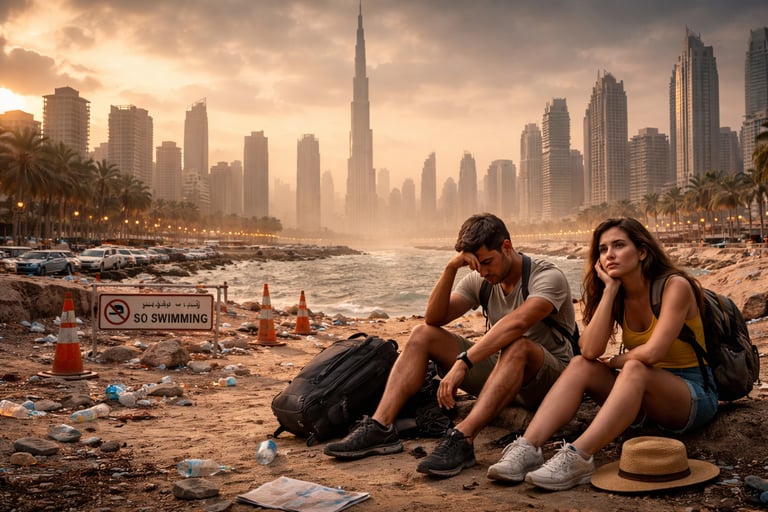
For over two decades, Dubai has marketed itself as a futuristic paradise—towering skyscrapers, luxury cars, man-made islands, and five-star everything. Instagram influencers, travel ads, and glossy brochures have sold Dubai as the ultimate travel destination.
But in 2026, that illusion is cracking.
More travelers are returning with disappointment instead of awe, frustration instead of wonder, and regret instead of memories. Beneath the glass towers and polished surfaces lies a destination that increasingly fails what modern travelers seek: authenticity, freedom, comfort, affordability, and genuine cultural connection.
This Travel Explorer deep-dive explains why Dubai is quietly becoming one of the worst places to travel in 2026, despite its wealth and hype.
1. Dubai Is Not a Real City — It Is a Carefully Managed Stage
Dubai does not grow naturally. It is engineered.
Every experience is controlled, curated, and sanitized. Streets feel empty. Neighborhoods lack soul. Local interaction is minimal. Unlike cities shaped by centuries of history, Dubai feels assembled, not lived in.
You do not “discover” Dubai.
You are directed through it.
For travelers seeking stories, imperfections, and organic culture, Dubai feels hollow—like walking through a luxury shopping mall that never ends.
2. Extreme Heat Makes Dubai Nearly Unlivable for Tourists
In 2026, climate conditions have worsened.
From April to October, temperatures frequently exceed 45–50°C. Even short outdoor walks become exhausting or dangerous. Sightseeing during daylight hours is almost impossible.
Dubai’s solution?
Air conditioning everywhere.
But that creates a strange travel experience:
You rush from hotel → taxi → mall → restaurant → hotel
Streets are avoided
Outdoor exploration disappears
Nature is almost irrelevant
A destination where you cannot comfortably walk outside for half the year is fundamentally broken for travelers.
3. Everything Is Artificial — Including the Experiences
Dubai excels at building replicas:
Artificial islands
Indoor ski slopes
Fake old towns
Simulated heritage villages
But travelers increasingly want real places, not climate-controlled illusions.
There is no authentic old city life.
No spontaneous street culture.
No unfiltered local rhythm.
Dubai replaces heritage with spectacle—and spectacle ages fast.
What felt impressive in 2015 feels empty in 2026.
4. Travel in Dubai Is Shockingly Expensive for What You Get
Dubai markets itself as luxury, but even basic travel costs are inflated:
Hotels charge premium prices without providing cultural value
Restaurants are overpriced and often average
Activities cost more than similar experiences in Europe or Asia
Hidden fees appear everywhere
You spend heavily, but return with shallow experiences.
Many travelers report feeling financially exploited, not enriched.
5. Dubai Is Emotionally Isolating for Visitors
One of the most common complaints in 2026 is emotional isolation.
Dubai lacks:
Street conversations
Friendly chaos
Community interaction
Shared public life
Most people you meet are either:
Overworked migrant laborers
Short-term tourists
Service staff instructed to remain formal
There is little warmth, little spontaneity, and little human connection.
For solo travelers especially, Dubai feels cold despite the heat.
6. Cultural Restrictions Create Constant Anxiety
Dubai claims to be modern, but social restrictions remain strict:
Public behavior is monitored
Affection can cause trouble
Speech is carefully controlled
Social media posts can create legal issues
Photography can lead to questioning
Travelers in 2026 increasingly value freedom—to speak, dress, express, and explore.
Dubai offers luxury, but not liberty.
That trade-off feels unacceptable to many modern travelers.
7. No Backpacker Culture, No Budget Travel Spirit
Dubai is hostile to:
Backpackers
Budget travelers
Long-stay explorers
Slow travel enthusiasts
There are:
Few affordable hostels
Limited public gathering spaces
No street food culture worth exploring
No creative subcultures
Everything is transactional.
Nothing is communal.
Travel becomes consumption, not exploration.
8. The “Luxury” Feels Repetitive and Soulless
Luxury in Dubai is not diverse—it is repetitive.
One mall feels like the next.
One skyscraper resembles another.
One luxury restaurant mirrors the last.
After three days, novelty fades.
After five days, boredom sets in.
Dubai lacks layers. Once you see the surface, there is nothing beneath it.
9. Nature Tourism Is Nearly Non-Existent
Aside from desert safaris—often criticized for animal welfare issues—Dubai offers minimal natural experiences:
No forests
No mountains
No rivers
Limited coastline access
Artificial beaches dominate
In 2026, nature-driven travel is growing globally.
Dubai cannot compete.
10. Ethical Discomfort Is Increasing Among Travelers
More travelers are questioning:
Labor conditions
Environmental sustainability
Excessive resource consumption
Social inequality
Dubai’s visual wealth contrasts sharply with the invisible labor supporting it.
For conscious travelers, this creates moral unease that ruins enjoyment.
Luxury feels uncomfortable when suffering is hidden behind it.
11. Over-Policing Kills Spontaneity
Dubai is safe—but at a cost.
Security cameras, rules, and surveillance remove:
Street performances
Political expression
Creative rebellion
Unexpected encounters
Travel becomes predictable.
Predictability kills adventure.
12. Dubai Is Built for Transit, Not Travel
Dubai excels as:
A layover city
A business hub
A shopping stop
But as a travel destination, it fails to sustain curiosity.
Many travelers now use Dubai only as a stopover, not a destination.
That shift is telling.
13. Comparison With Better Alternatives in 2026
For the same budget, travelers can choose destinations that offer:
Culture
Freedom
Nature
History
Human connection
Dubai struggles against cities that feel alive, imperfect, and real.
Modern travelers want experience, not excess.
14. The Instagram Trap Is Collapsing
Dubai photographs well.
But lived experience does not match images.
Travelers in 2026 are increasingly disillusioned with destinations built for social media rather than soul.
Dubai is optimized for the camera—not for memory.
15. Why Travel Explorer Flags Dubai Negatively in 2026
From a Travel Explorer perspective, Dubai fails core travel values:
Authenticity ❌
Cultural depth ❌
Accessibility ❌
Sustainability ❌
Emotional engagement ❌
It succeeds only in:
Visual impact
Luxury branding
Short-term spectacle
That is no longer enough.
Final Verdict: Is Dubai the Worst Place to Travel in 2026?
Dubai is not dangerous.
Dubai is not poor.
Dubai is not ugly.
But it is empty.
In 2026, travelers seek:
Stories over selfies
Freedom over rules
Culture over consumption
Connection over comfort
Dubai offers the opposite.
That is why, despite its wealth and ambition, Dubai is increasingly considered one of the worst places to travel in 2026.
Not because it lacks money—
but because it lacks meaning.
© 2026. All rights reserved.