
Why India Is Losing Tourists in 2026: Structural Problems the Travel Industry Can No Longer Ignore
Why India Is Losing Tourists in 2026. This in-depth Travel Explorer analysis explains the real reasons behind falling tourist numbers, from visa friction and infrastructure gaps to safety perception, pricing issues, and regional competition.
ASIA
1/13/20263 min read
Introduction: A Tourism Paradox in 2026
India has always been marketed as a land of contrasts—ancient civilizations, spiritual depth, diverse geography, and unmatched cultural density. Yet, in 2026, a paradox is becoming increasingly clear: India is losing tourists while global travel demand is rising.
Countries across Southeast Asia, the Middle East, and even parts of Africa are breaking tourism records, while inbound leisure travel to India is either stagnating or declining in key source markets. This trend is not accidental, temporary, or purely economic. It is the result of systemic structural issues that India has failed to address at scale.
This Travel Explorer investigation breaks down why India is losing tourists in 2026, using policy analysis, traveler behavior patterns, and competitive benchmarking with rival destinations.
1. Complicated and Inconsistent Visa Experience
While many countries have simplified entry to boost tourism, India’s visa regime in 2026 remains unpredictable and inconsistent.
Key Problems
Sudden suspension or restriction of e-visas for certain nationalities
Lengthy processing times for physical visas
Limited transparency on rejections
Poor communication from embassies and portals
In contrast, destinations like Thailand and Vietnam offer:
Instant or near-instant e-visas
Clear validity rules
Multi-entry tourist options
Modern tourists prioritize ease of entry, especially digital nomads, short-term travelers, and families. India continues to treat tourism visas as a security-first process rather than an economic growth tool.
2. Infrastructure That Does Not Match Tourist Expectations
India has world-class airports in select cities, but the experience collapses beyond arrival halls.
Transport and Connectivity Issues
Poor last-mile connectivity from airports
Inconsistent railway cleanliness and punctuality
Limited tourist-friendly intercity transport
Confusing ticketing systems for foreigners
Tourists compare experiences globally. When travelers can move seamlessly between cities in Japan or enjoy predictable bus and ferry networks in Bali, India’s fragmented system becomes a dealbreaker.
3. Safety Perception and Reputation Damage
One of the most damaging factors in 2026 is perception, not just reality.
Key Concerns Among Foreign Tourists
Safety of women travelers
Harassment and scams
Aggressive touts at tourist sites
Viral social media incidents
Even isolated incidents, when amplified globally, damage destination trust. Countries like Sri Lanka and Nepal actively manage tourist-police units and crisis communication. India does not.
Tourism is an emotional decision. Perceived risk equals lost bookings.
4. Overcrowding Without Capacity Management
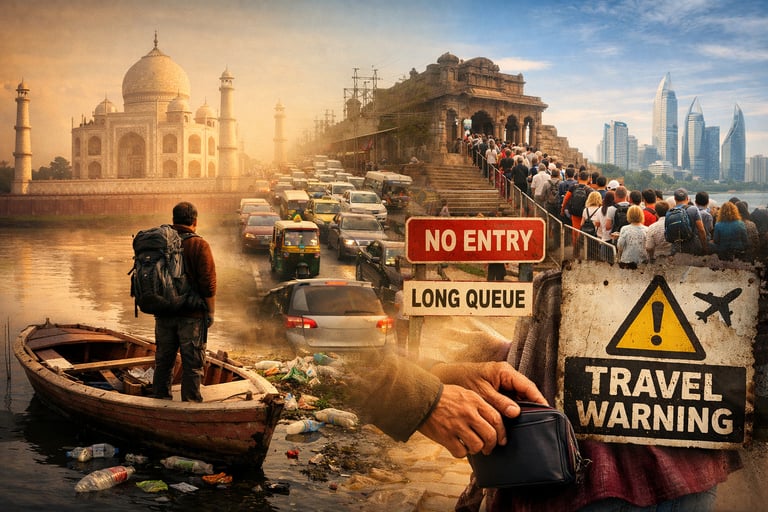
India attracts tourists, pilgrims, and domestic travelers simultaneously—but without capacity regulation.
Resulting Problems
Overcrowded monuments and religious sites
Environmental degradation
Poor visitor experience
Long queues without digital booking systems
Destinations that thrive in 2026 implement:
Timed entry systems
Visitor caps
Dynamic pricing
India largely relies on volume instead of experience quality, making repeat visits unlikely.
5. Poor Pricing Transparency and Tourist Exploitation
One of the most common complaints in traveler reviews is pricing inconsistency.
Typical Tourist Experiences
Dual pricing without explanation
Inflated taxi and guide rates
Variable hotel pricing without service parity
Hidden fees
While price differentiation is not unique to India, lack of transparency destroys trust. Competing destinations provide clear, digital, pre-bookable pricing across transport, attractions, and tours.
6. Weak Digital Tourism Ecosystem
In 2026, tourism is driven by:
Mobile-first planning
Unified booking platforms
AI-assisted itinerary creation
India lacks a centralized, traveler-centric digital ecosystem.
Gaps Include
No national tourism super-app
Fragmented state tourism portals
Limited real-time information
Poor multilingual support
Tourists today expect the convenience they get in fintech or food delivery apps. India’s tourism tech stack is outdated.
7. Environmental Degradation and Neglect
Environmental awareness among travelers has increased sharply post-2024.
Issues Hurting India’s Image
Plastic waste in tourist zones
River pollution
Poor waste management in hill stations
Unregulated construction
Eco-conscious travelers are choosing destinations that align with sustainability values. India markets spirituality and nature but fails to protect them at scale.
8. Competition From More Agile Destinations
India is no longer competing only with legacy tourism hubs. It is losing tourists to faster, cleaner, simpler destinations.
Why Competitors Are Winning
Faster visas
Better infrastructure
Safer perception
Lower friction
Tourism is not about patriotism—it is about value for time and money.
9. Inconsistent Service Standards
Service quality in India is highly inconsistent.
Excellent in luxury hotels
Poor in mid-range experiences
Unregulated tour operators
No unified service certification
Inconsistent service makes itinerary planning risky for first-time visitors.
10. Weak Destination Branding Strategy
India’s tourism marketing still relies on generic slogans rather than targeted campaigns.
Missing Elements
Segmentation by traveler type
Country-specific marketing
Influencer trust-building
Crisis response narratives
Destinations that dominate tourism in 2026 speak directly to:
Solo travelers
Digital nomads
Families
Senior tourists
India speaks to everyone—and convinces no one.
11. Domestic Tourism Crowding Out International Tourists
India’s booming domestic tourism has an unintended side effect: international tourists feel deprioritized.
Hotels focus on volume, not experience
Language barriers increase
Attractions cater to domestic preferences
Balanced tourism policy is missing.
12. Policy Gaps and Fragmented Governance
Tourism in India is split between:
Central government
State tourism boards
Municipal bodies
There is no unified execution authority, leading to slow reforms and inconsistent standards.
What India Must Do to Reverse the Decline
If India wants to regain global tourist confidence, it must:
Simplify and stabilize visa policy
Build tourist-first infrastructure
Actively manage safety perception
Regulate pricing and services
Invest in a unified digital tourism platform
Enforce sustainability standards
Redefine destination branding
Tourism is not just about arrivals—it is about experience economics.
Conclusion: A Wake-Up Call for Indian Tourism
India is not losing tourists because it lacks beauty, history, or culture. It is losing tourists because global travelers have options, and India has failed to modernize the tourism experience at the same pace.
The decline in 2026 should be seen as a warning—not a defeat.
Unless structural reforms are implemented, India risks becoming a one-time destination instead of a repeat favorite.
© 2026. All rights reserved.