
Why Thailand Hasn’t Banned Sex Tourism in 2026 — The Hidden Economic Engine of Its Tourism Industry
Despite global pressure to curb adult tourism, Thailand in 2026 continues to walk a fine line between regulation and tolerance. Discover why the country still hasn’t banned sex tourism, its impact on the economy, culture, and how it shapes Thailand’s travel identity. (Reference: Travel Explorer 2026)
ASIA
11/3/20254 min read
The Hidden Side of Thailand’s Tourism Industry
Thailand is globally known for its beaches, temples, street food, and hospitality. But beneath this polished image lies a complex reality that is rarely discussed openly — sex tourism.
In 2026, despite global pressure and repeated policy discussions, Thailand has still not imposed a complete ban. Instead, the country continues to manage and contain the industry rather than eliminate it.
This is not accidental. It is driven by economic dependence, cultural pragmatism, historical roots, and political strategy.
This Travel Explorer analysis explains why sex tourism still exists in Thailand, why it is tolerated, and why banning it is far more complex than it appears.
The Economic Reality Behind Sex Tourism in Thailand
Sex tourism operates as an unofficial yet deeply embedded economic layer within Thailand’s tourism ecosystem.
Thailand attracts millions of tourists every year. While many come for beaches and culture, a portion is drawn by its permissive nightlife environment.
Although not formally recorded, the economic impact spreads across multiple sectors:
Hotels and short-term accommodations
Bars, clubs, and nightlife venues
Transport services and taxis
Street food and late-night businesses
Rental apartments and entertainment districts
Even conservative estimates suggest billions of dollars in indirect contribution annually.
Why a Ban Is Economically Risky
Tourism forms a major part of Thailand’s economy. Entire regions depend on visitor spending.
A complete ban could result in:
Mass job losses
Reduced tourist inflow
Collapse of nightlife economies
Shift to underground and unregulated activity
From a policy perspective, the economic cost of banning is higher than tolerating.
The Legal Gray Zone — Illegal but Not Fully Enforced
Technically, prostitution is illegal in Thailand. Laws prohibit solicitation, brothel operations, and facilitation.
However, enforcement is selective, creating a legal gray zone.
Many venues operate under indirect labels such as:
Entertainment venues
Massage services
Hostess bars
Companionship services
This allows authorities to control visibility without eliminating the system.
Why Enforcement Is Limited
Local informal regulation systems
Economic dependency on tourism
Social normalization in nightlife areas
Focus on serious crimes over consensual activity
Thailand’s strategy is not eradication — it is containment and control.
Historical Roots of Thailand’s Sex Tourism Industry
Thailand’s adult tourism industry did not emerge overnight.
Its origins trace back to the mid-20th century, when the country served as a rest-and-recreation hub for foreign military personnel.
Over time, these entertainment zones transitioned into civilian tourism infrastructure, evolving into:
Established nightlife districts
Multi-generational service economies
Urban zones built around tourism demand
By the time Thailand became a global travel destination, this system was already deeply integrated.
Socioeconomic Drivers — Why the Industry Continues
A major factor behind the persistence of sex tourism is economic inequality.
Many workers migrate from rural areas where opportunities are limited. Tourism cities offer significantly higher earning potential.
For some individuals, this work provides:
Financial independence
Family support
Education funding
Savings for future businesses
Cultural Perspective
Thai society often values:
Practical solutions over confrontation
Economic survival over strict moral enforcement
Social harmony over public conflict
This leads to pragmatic tolerance rather than aggressive prohibition.
Political Reality — Why Governments Avoid a Clear Ban
Thai governments have repeatedly promised reforms, but major structural changes rarely occur.
This is because the issue sits at a sensitive intersection:
Banning risks economic damage
Legalizing risks social backlash
Strict enforcement risks international criticism
As a result, policymakers follow a strategy of controlled ambiguity — discouraging publicly while allowing controlled operation privately.
Dual Image Strategy — Two Versions of Thailand
Thailand operates with two parallel tourism identities:
A cultural, spiritual, family-friendly destination
A nightlife hub for adult-oriented travelers
Official tourism campaigns focus on temples, beaches, and wellness.
Meanwhile, nightlife markets itself informally through digital platforms and word-of-mouth.
This dual strategy allows Thailand to capture multiple travel segments without direct acknowledgment.
Ethical Debate — Ban vs Regulation
The debate around sex tourism is shifting globally.
Critics argue it leads to exploitation and harms national image.
Supporters argue criminalization pushes the industry underground and increases risk.
Thailand’s current approach allows:
Health outreach programs
Basic safety monitoring
Community-level support systems
The focus is increasingly on harm reduction rather than strict prohibition.
Global Comparison — Thailand Is Not Alone
Many countries regulate or tolerate sex work in different forms.
What makes Thailand unique is:
Scale of the industry
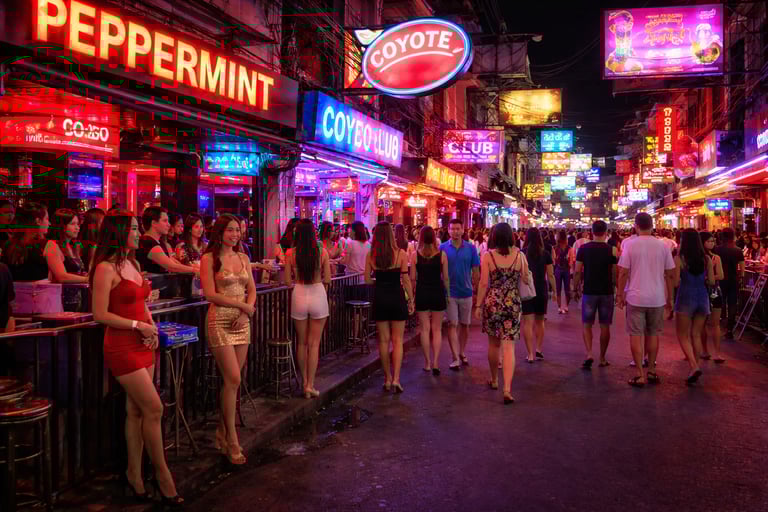
Visibility within tourism zones
Integration with mainstream travel infrastructure
Adult entertainment districts exist alongside hotels, malls, and public transport — making complete bans harder to implement.
Technology in 2026 — A Shift Toward Privacy
The industry has evolved significantly with technology.
Instead of street-based interactions, connections now happen through:
Private messaging apps
Online platforms
Closed networks
Pre-arranged services
This shift has made the industry more discreet and harder to regulate, reducing the effectiveness of traditional enforcement.
Voices from Within — What Workers Actually Want
Many individuals within the industry do not support complete bans.
Common priorities include:
Safety and legal protection
Access to healthcare
Stable income
Freedom from harassment
The demand is increasingly for rights and regulation, not elimination.
Will Thailand Ban Sex Tourism in the Future?
A complete ban remains unlikely.
Demand would not disappear — it would shift underground or to other countries.
A more realistic future includes:
Partial legalization frameworks
Licensed entertainment zones
Health and safety regulations
Taxation systems
Thailand is more likely to evolve toward regulated management rather than prohibition.
What This Means for Travelers in 2026
For travelers, the landscape is changing.
Adult nightlife still exists, but it is becoming more discreet and controlled.
Travelers are expected to:
Respect local laws and culture
Avoid exploitative or illegal activities
Stay within legal boundaries
Support ethical and responsible tourism
Future Outlook — Adaptation, Not Elimination
As Thailand’s economy grows, its reliance on tourism may reduce — but it will not disappear.
The industry is expected to:
Become more private and digital
Shift toward premium clientele
Integrate into regulated frameworks
Reduce public visibility
The future is defined by adaptation rather than removal.
Final Conclusion — The Pragmatic Truth
Thailand has not banned sex tourism in 2026 because doing so would create more problems than it solves.
Economic dependence, cultural realities, historical integration, and political strategy all point toward management instead of elimination.
This reflects a broader global reality — demand for adult services does not disappear through laws alone.
Thailand’s approach is not about approval or denial. It is about pragmatic governance in a complex system.
© 2026. All rights reserved.