
Why Tourists Are Banned From Most of Antarctica – The Hidden Rules, Data, and Reality Behind the World’s Most Restricted Continent
Discover why 99% of Antarctica is off-limits to tourists. Real rules, data, costs, and hidden restrictions explained with facts most travel blogs ignore.
ANTARCTICA
3/24/20263 min read
Antarctica Is Not a Tourist Destination — It Is a Controlled Scientific Zone
Antarctica is often presented as the last untouched travel destination, but in reality, it operates under one of the strictest global governance systems.
Unlike any other continent, Antarctica is not owned by a single country. It is managed through international agreements where tourism is allowed only under tightly controlled conditions.
This means you are not freely “visiting” Antarctica — you are being granted limited, regulated access.
The Legal System That Controls Antarctica
Antarctica is governed by the Antarctic Treaty System, signed in 1959 and supported by more than 50 countries.
This system enforces strict rules:
No military activity is allowed.
No mining or resource extraction is permitted.
Scientific research is the top priority.
Environmental protection overrides all other activities.
Tourism exists, but legally it is considered secondary and restricted.
How Much of Antarctica Can Tourists Actually Visit
Antarctica is massive, covering around 14 million square kilometers.
However, less than 0.5% of this area is accessible to tourists.
More than 95% of travelers only visit the Antarctic Peninsula, which is the most accessible and relatively safer region.
The vast interior of Antarctica remains completely off-limits for normal tourism.
Tourism Growth vs Strict Limits
Tourism is increasing, but access remains controlled.
Around 33,000 people visited Antarctica in 2010.
By 2020, this number grew to around 74,000.
In the 2024–2025 season, it crossed 120,000 visitors.
Despite this growth, strict operational limits exist:
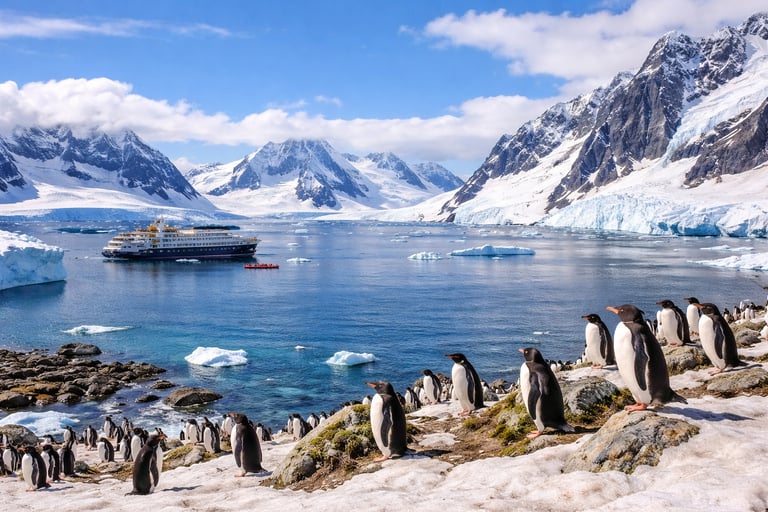
Only ships with fewer than 500 passengers are allowed for landings.
Only 100 people can be on land at the same time.
This controlled system ensures demand grows, but impact remains limited.
Who Actually Controls Tourism Operations
Tourism is managed by the International Association of Antarctica Tour Operators (IAATO).
This organization ensures that every operator follows strict environmental and safety standards.
All expeditions must follow approved routes.
Landing sites are pre-defined and limited.
Tourist behavior is constantly monitored.
Environmental impact must be minimized at all times.
Without IAATO compliance, tourism operations are not allowed.
Why 99% of Antarctica Is Restricted
Environmental Sensitivity
Antarctica has one of the most fragile ecosystems on Earth.
Damage to moss or plant life can take decades to recover.
Wildlife breeding cycles are extremely sensitive.
Even small human interference can disrupt natural balance.
The environment cannot handle large-scale tourism.
No Infrastructure or Emergency Support
Antarctica has no cities, no hospitals, and no commercial rescue systems.
If something goes wrong, evacuation becomes extremely complex and expensive.
Emergency evacuations can cost anywhere from ₹20 lakh to over ₹1 crore depending on conditions.
This makes unrestricted travel unsafe and impractical.
Extreme Weather Conditions
Antarctica is one of the harshest environments on Earth.
Winter temperatures can drop below -50°C.
Wind speeds can exceed 200 km/h.
Whiteout conditions can occur without warning.
Only trained expeditions with proper equipment can operate safely.
Scientific Research Priority
There are more than 70 research stations across Antarctica.
These stations study climate change, ice core data, and marine ecosystems.
Tourism is not allowed to interfere with scientific operations, which is why large areas remain restricted.
Strict Rules Every Tourist Must Follow
Even in allowed areas, rules are extremely strict.
Only 100 passengers are allowed on land at a time.
Tourists must maintain distance from wildlife.
Touching animals is strictly prohibited.
No food is allowed on land.
Boots must be disinfected before every landing.
Every movement is supervised by trained expedition guides.
What You Are Not Allowed To Do
Tourists do not have freedom like other destinations.
You cannot travel independently.
You cannot explore freely.
You cannot collect rocks, ice, or natural elements.
You cannot use drones without permission.
You cannot stay outside approved expedition plans.
Everything is controlled and monitored.
Why Antarctica Is So Expensive
The restrictions directly increase cost.
Limited ships reduce supply.
Strict regulations increase operational expenses.
Fuel and logistics in extreme conditions are costly.
Safety systems require advanced infrastructure.
This is why Antarctica trips usually range between ₹10 lakh to ₹20 lakh or more.
The Psychological Reason Demand Is Increasing
Despite restrictions and high cost, demand continues to grow.
People are attracted by the idea of visiting the last untouched place on Earth.
There is also a strong scarcity factor, as very few people ever visit Antarctica.
For many travelers, it represents status, exclusivity, and a once-in-a-lifetime experience.
The 2048 Factor — A Future Shift
A key agreement called the Madrid Protocol bans mining in Antarctica until 2048.
After this, policies could change.
This raises important questions:
Will Antarctica open for economic use?
Will tourism become more accessible or more restricted?
For now, strict control remains essential for preservation.
Final Insight
Antarctica is not restricted to stop people from visiting.
It is restricted to protect one of the last untouched ecosystems on Earth.
The limited access, strict rules, and high cost are all part of a system designed to preserve the continent for future generations.
Conclusion
If Antarctica were open like other destinations, it would lose its uniqueness very quickly.
The restrictions are not a limitation — they are the reason Antarctica still exists in its purest form.
That is what makes it one of the most extraordinary places on Earth.
© 2026. All rights reserved.